
What to Expect During Flooring Installation
Published August 18, 2026 | Bruce® Flooring Expert
The hard part is over. You’ve chosen a floor, visited a retailer, signed a quote, and scheduled a date.
Then, the week before installation arrives, the questions start. Do I need to move the furniture? Will the dog be okay? How long will my kitchen be unusable? What happens if they find something under the old floor?
Installation is a construction project that takes place inside your house. It’s noisy, it’s dusty, and for a few days your rooms belong to someone else. None of that is a problem when you know it’s coming.
Here’s what actually happens, in order.
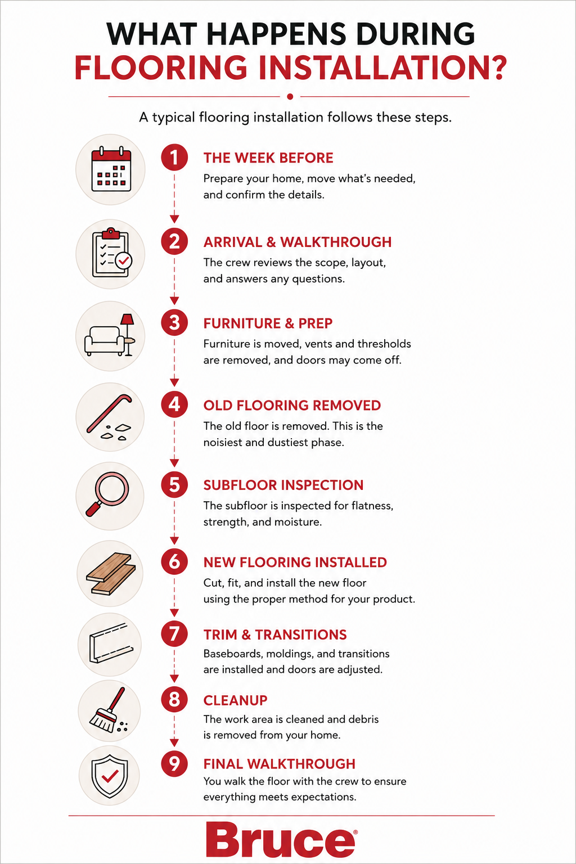
The Week Before
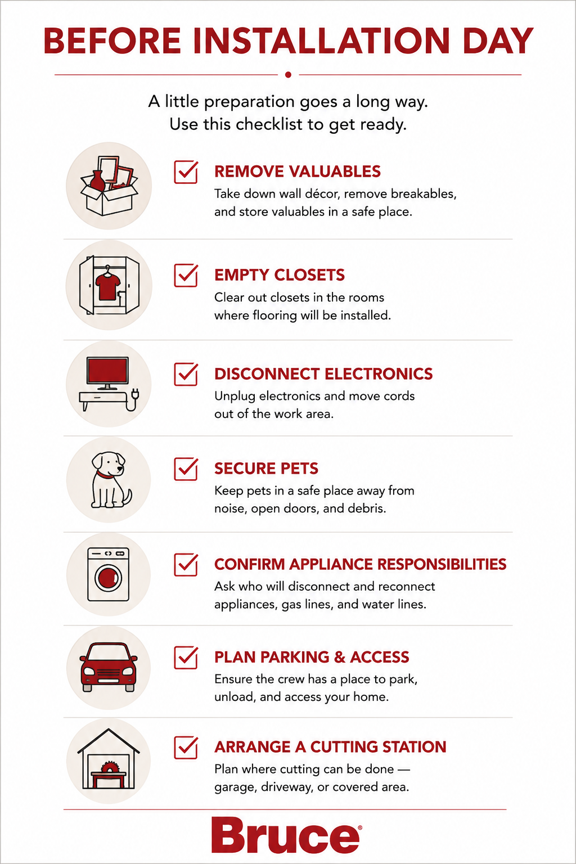
Most of your work happens before anyone arrives.
Sort Out Furniture Early
Whether installers move it varies by company, product, and contract — some include it, some charge for it, some won’t touch it at all. Confirm this in writing before installation day, not the morning of.
If they do move it, ask what’s excluded. Pianos, safes, aquariums, pool tables, and anything requiring service are commonly the homeowner’s responsibility.
Clear What the Installer Won’t Handle
Regardless of who moves the couch, plan to handle:
- Anything breakable or valuable
- Pictures and mirrors on the walls, as a nail-down installation, vibrate the whole room.
- Electronics, disconnected and unplugged
- Contents of closets in the affected rooms
- Curtains and blinds that hang low
- Small items on shelves and mantels
Appliances Need a Plan
Refrigerators, washers, dryers, and dishwashers often need to be disconnected. Gas lines and water lines usually require a professional. Ask who’s responsible. This causes more installation-day delays than almost anything else.
Make a Plan for Pets and Kids
Doors stay open, tools are loud, and sharp offcuts and adhesive will be within reach. Boarding the dog or arranging a day out is worth it for everyone.
Handle the Logistics
Where will the crew park and unload? Are there HOA restrictions on hours? Do they need a gate code or a key? Where can they set up a cutting station — in a garage, on a driveway, or on a covered porch? Cutting happens outside when weather allows, inside when it doesn’t.
Know Where Your Floor Is
Some products need to sit in your house before installation. That’s the next section, and it can shift your schedule by several days.
Why Wood Floors Need Time to Acclimate
Wood is a natural material, and it never fully stops responding to its environment. It takes on moisture when the air is humid and releases it when the air is dry, expanding and contracting slightly in the process.
That’s not a defect. It’s the reason wood floors need to arrive early.
Acclimation means letting the flooring sit inside your home. Ideally, in the rooms where it will be installed, until its moisture content balances with your conditions. If you install wood that’s wetter than your house, it will shrink after installation. That will open gaps between boards. Install drier wood, and it will expand. That potentially leads to buckling or cupping.
Requirements for Acclimation
How long depends on the product and your home’s conditions — commonly a few days, sometimes longer. The manufacturer’s instructions set the requirement. And keep this in mind: following them is usually a warranty condition.
Two things acclimation requires from you:
- The house needs to be at normal living temperature and humidity during that window
- The flooring needs to be stored in the actual rooms, not stacked in the garage
A house that’s been empty and unheated during a renovation isn’t in living condition. Acclimating to those conditions doesn’t help.
Resilient products behave differently. Luxury vinyl plank, rigid core, and laminate are dimensionally more stable than wood. Most need only 24 to 48 hours at room temperature. That’s enough to bring the material to room temperature before installation. The requirement still exists; it’s just shorter.
Should You Stay Home During Installation?
You don’t have to stay home the whole time, but you should remain available by phone. Installers sometimes need quick decisions about layout direction, transition placement, or unexpected subfloor repairs. Being reachable keeps the project moving.
Two moments are worth being physically present for:
- The morning walkthrough, when the crew confirms scope and layout so you can flag anything unusual
- The final walkthrough, when you inspect the work while the tools are still in the driveway.
In between, you don’t need to supervise. Hovering doesn’t speed anything up, and installers work faster in a room where they can spread out. If you’re working from home, expect noise loud enough to make calls difficult, and plan around it.
What Happens on Installation Day
Every install runs a little differently, but the sequence rarely changes. Here’s the order it typically follows.
Arrival and Walkthrough
The crew confirms the scope, the rooms, and the layout direction. Here is when to point out anything unusual. That can include a squeaky spot, a threshold that’s always bothered you, or a door that already sticks.
Furniture and Prep
Whatever’s being moved gets moved. Floor vents and thresholds come up. Doors may come off their hinges.
Old Flooring Comes Out
This step is the loudest, dustiest phase. Carpet and pad pull up quickly; tile and thinset are slow, heavy work. Old adhesive may need to be scraped or ground off. Expect noise, expect dust despite containment, and expect the house to feel disrupted.
The Subfloor Gets Inspected
The subfloor gets inspected. This stage is most likely to uncover unexpected issues. More on this below.
Installation Begins
Cut, fit, fasten, repeat. The method depends on your product. Nailed or stapled for solid wood. Glued for many engineered products. Click-together and floating for the most resilient flooring. Installers typically work from several cartons at once, so natural variation is distributed evenly rather than pooling in one corner.
Trim and Transitions
Baseboards or quarter-round go back, thresholds and reducers are set, and doors are rehung and trimmed if the new floor sits higher.
Cleanup and Walkthrough
Debris is removed, the floor is swept or vacuumed, and then you walk it with the crew lead.
A single bedroom is usually a one-day job. A main floor typically runs two to four days. Whole-home projects, stair installations, tile, and anything needing subfloor repair take longer. Weather matters more than people expect, since cutting often happens outside.
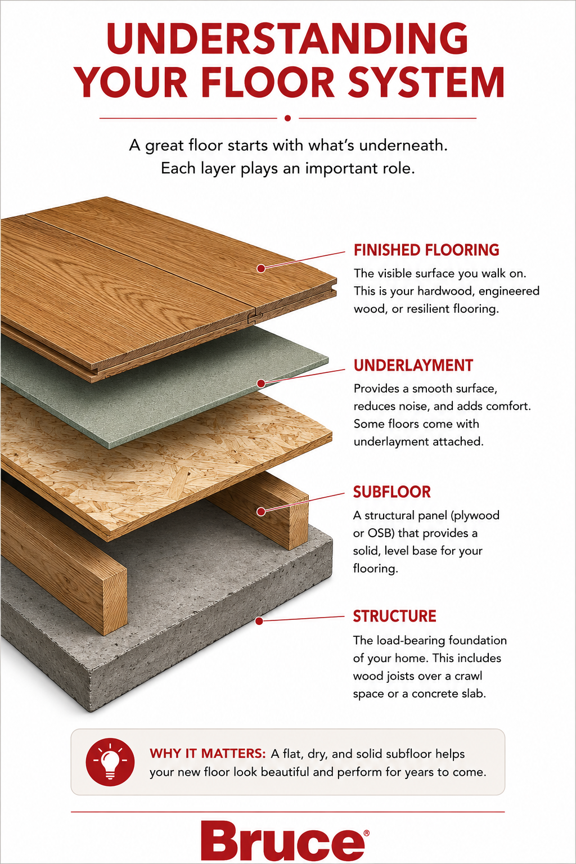
What’s Under Your Floor, and Why It Matters
Your subfloor is the structural layer beneath everything. It’s usually plywood or OSB over joists, or a concrete slab in basements and slab-on-grade homes. It’s what your finished floor is attached to, and its condition determines whether that floor performs.
Three things matter:
1. Flatness
Most manufacturers specify a tolerance, something like 3/16 of an inch over ten feet. A subfloor outside that range causes hollow spots, flexing, and squeaks. On floating floors, it can stress the locking system to the point where joints separate.
2. Dryness
Concrete slabs release moisture for years, sometimes indefinitely. That’s why moisture testing exists and why some products require a barrier over concrete. Wood subfloors have their own moisture limits. The difference between subfloor and flooring moisture content is often specified too.
3. Soundness
Loose panels, damaged plywood, and inadequate fastening cause squeaks and movement no finished floor can hide.
Here’s the part nobody prepares homeowners for. You can’t fully assess any of this until the old floor comes off. A pre-installation measure catches a lot, but the layer underneath stays hidden until installation day.
So when installers find rot near a bathroom, an unexpectedly out-of-level slab, or a section of soft plywood, that isn’t a problem with the job. It’s a discovery. That’s why the work happens on a day when it can still be fixed cheaply.
The most expensive flooring mistake isn’t choosing the wrong color. It’s installing the right floor over the wrong subfloor.
What Happens with Subfloor Concerns?
Work stops in that area. Someone documents it and explains the scope. You will receive a price for the additional work, and you can decide. Then the schedule adjusts if needed.
What to Ask Before Installation Day
You’ll want to determine how discoveries get communicated and whether they’ll wait for your approval before proceeding. Most importantly, you’ll want to find out how additional work gets priced — hourly, by the square foot, or by written change order.
Installing a finished floor over a compromised subfloor doesn’t hide the problem. It buries it under something you just paid for, and it usually voids the warranty.
When Can You Walk on an Installed Floor?
It’s the most common question. The answer depends entirely on how your floor was installed.
Floating Floors
Most laminate, luxury vinyl plank, and rigid core are floated and ready essentially right away. Nothing is curing, so light foot traffic is fine as soon as the crew is finished.
Nail-Down and Staple-Down
Solid or engineered wood is also walkable immediately. The fasteners hold; there’s nothing to set.
Glue-Down
Glue-down floors need the adhesive to cure. Light foot traffic is typically fine after 24 hours, but check the manufacturer’s specification. Some adhesives need longer curing times, and humidity slows curing.
Site-Finished Wood
Site-finished hardwood requires the longest wait. If your floor is sanded and finished in place, the finish needs to cure. Depending on the product, that’s typically 24 to 48 hours before light traffic in socks and several days before shoes. It can take up to a few weeks for the finish to reach full hardness. Prefinished flooring, which is most of what’s sold today, skips this entirely.
Pets Should Wait Longer Than People
Nails concentrate weight on small points and on a curing surface, leaving marks that don’t buff out.
When Can Furniture Go Back?
Different question, longer answer.
Even on a floating floor, you can walk on it immediately; heavy furniture is a different load. Two general rules:
- Wait for the cure. On glue-down and site-finished floors, heavy furniture goes back after the adhesive or finish has fully cured, not just after it’s walkable. That’s typically 24 to 72 hours for adhesive and can be considerably longer for a site finish.
- Never drag anything. Lift it. One heavy piece dragged across a new floor produces a scratch you’ll see every day for a decade.
Before anything goes back:
- Felt pads on every leg, including chairs and stools
- Wide-caster or hard-surface-rated wheels on rolling furniture
- A protective mat under rolling office chairs
- Appliances moved on appliance rollers or hardboard runners, never slid
Area Rugs Require Patience
On site-finished floors, wait until the finish has fully cured. A rug traps solvents and prevents curing beneath it, which can leave a permanent outline. Even on prefinished wood, wait a few weeks before covering large areas. Use a rug pad rated for hardwood. Some rubber-backed pads discolor finishes.
The Final Walkthrough After Installation
Do this before the crew leaves. It’s much easier to have someone fix something while their tools are still in your driveway.
Walk the Whole Floor in Socks
You’ll feel movement, hollow spots, and raised edges you won’t see.
Look Along the Floor at Eye Level
Check the flooring from a low angle, with the lights on. Surface defects that vanish when you’re standing disappear entirely from above.
Check:
- Boards seated flat, with no lifting or rocking
- No hollow sounds underfoot
- Consistent gaps at walls, hidden by trim or shoe molding
- Transitions secure and flush at doorways
- Trim reinstalled cleanly, gaps caulked or filled
- Doors opening and closing without dragging
- Vents and thresholds reinstalled
- No visible scratches, dents, or damaged boards
- Color variation distributed evenly, not clustered
- Debris and offcuts removed
Get the Paperwork Before The Installer Leaves
That includes:
- The completed installation contract
- The manufacturer’s warranty documentation
- Care and cleaning instructions
- The list of approved cleaners
- The product name, color, and lot number for your records
Ask for the Leftover Material
Extra cartons are yours if you paid for them. One unopened carton stored flat indoors is worth far more than it cost you the first time a board gets damaged. Confirm this in advance, as some contracts require unopened cartons to be returned to the retailer.
Note anything unresolved in writing before you sign off.
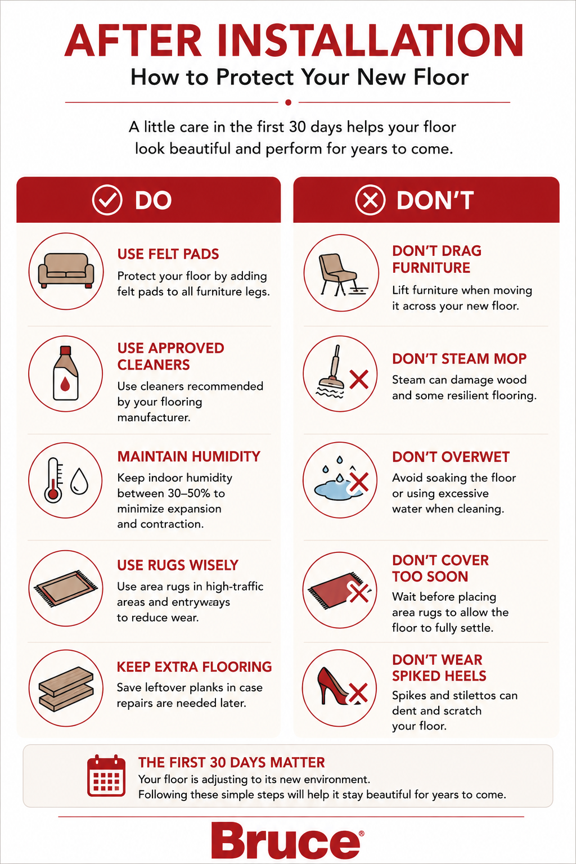
The First Thirty Days After Flooring Installation
New floors need a little care while everything settles. These care instructions also apply throughout the life of your floor to ensure optimal performance.
Keep Your Home at Normal Living Conditions
Wood responds to humidity year-round, and manufacturers specify a range, commonly 30 to 50 percent relative humidity. Winter heating dries indoor air enough to shrink boards and open seasonal gaps; humid summers do the reverse. A humidifier or dehumidifier is the fix, and maintaining that range is often a warranty condition.
Use Only Approved Cleaners
The wrong product can dull, streak, or damage a finish. Equally important, using the wrong product can void your coverage. Steam mops are prohibited on most wood floors. Oil soaps, wax, vinegar solutions, and all-purpose sprays are also prohibited.
Never Soak the Floor
Damp-mop with a well-wrung microfiber and let it dry quickly. Standing water finds seams.
Clean Grit Regularly
Sand and dirt tracked in from outside are abrasive and cause more finish wear than foot traffic. Mats at every entrance and regular sweeping or vacuuming on a hard-floor setting do most of the work.
Expect Some Settling
Minor seasonal gapping in wood is normal, not a defect. If something looks wrong, such as persistent cupping, boards lifting, or a spot that gives underfoot, document it with photos. Contact your flooring retailer while everything is fresh.
Your Floor Is In
Installation is a few disruptive days in exchange for something you’ll live on for decades. Knowing the sequence, including the prep, the acclimation, the discoveries, and the waiting, is what turns those days from stressful into simply busy.
If you’re earlier in the process, our guides to buying flooring for the way you live and preparing for a flooring retailer visit cover the decisions that come first.
Find a Bruce retailer near you when you’re ready to start.
Frequently Asked Questions About Flooring Installation
How long does flooring installation take?
A single room is typically one day. A main floor usually runs two to four days. Whole-home projects, stairs, tile, and subfloor repair extend that. Acclimation may add several days before installation begins.
Do floor installers move furniture?
It varies by company and contract. Some include it, some charge extra, some require the homeowner to clear rooms entirely. Pianos, safes, aquariums, and appliances requiring disconnection are commonly excluded. Confirm in writing before installation day.
Should I stay home during installation?
You don’t need to be there every minute, but stay reachable by phone. Be present for the morning and final walkthroughs. Those are the two moments your input matters most.
What happens if installers find subfloor damage?
Work pauses in that area, the issue is documented, and you’re given a price for the additional repair before it proceeds. Ask in advance how discoveries are communicated and priced.
How soon can I walk on new flooring?
Floating and nail-down floors are walkable immediately. Glue-down typically needs about 24 hours for the adhesive to set. Site-finished wood takes the longest. It often requires 24 to 48 hours for light traffic in socks and considerably longer for full cure.
When can I put furniture back after flooring installation?
After the adhesive or finish has fully cured, not just after the floor is walkable, that’s typically 24 to 72 hours for glue-down and longer for site finishes. Lift furniture rather than dragging it, and add felt pads to every leg first.
Do hardwood floors need to acclimate?
Wood flooring needs time in your home to balance with your temperature and humidity before installation. The manufacturer sets the requirement, and following it is typically a warranty condition. Resilient products need much less, often 24 to 48 hours.
When can I put area rugs down?
Wait until any finish has fully cured. A rug can trap solvents and leave a permanent outline. Even on prefinished floors, give it a few weeks and use a rug pad rated for hardwood.
What happens to leftover flooring?
Ask before installation. Extra material you paid for is generally yours, though some contracts require you to return unopened cartons. Keep at least one carton stored flat indoors. Production runs vary, and a future repair may not match otherwise.
How much does flooring installation cost?
According to a 2026 USA TODAY analysis, labor typically ranges from $1.50 to $12 per square foot, depending on the material, the required prep, and your location. This, however, is only an estimate. Tile and stone sit at the high end; carpet and laminate at the low end. Subfloor repair discovered during installation is priced separately.