
Acclimating Wood Floors: Skipping This Step Can Cost You Later
Hardwood flooring is an investment. It changes how your home feels the moment you install it.
But what happens before installation determines how that floor performs for decades.
Wood absorbs moisture when the air is humid and releases it when the air is dry. When you install flooring before it adjusts to your home’s climate, that movement doesn’t stop once you nail down the boards. It begins after installation.
That’s when gaps form. Boards lift and surfaces cup. Cracks appear. Warranties get questioned. The floor didn’t fail. The installation process did.
Acclimation prevents all of it. And it’s the most overlooked step in the entire installation process.
Key Takeaways
- Acclimation allows wood flooring to stabilize in your home before installation.
- Skipping acclimation is one of the most common reasons wood floors fail.
- Most hardwood floors need several days under real living conditions to adjust.
- Temperature, humidity, and airflow must remain consistent during acclimation.
- Engineered hardwood still typically requires acclimation as a best practice, even though it stabilizes faster than solid wood.
What is Wood Acclimation?
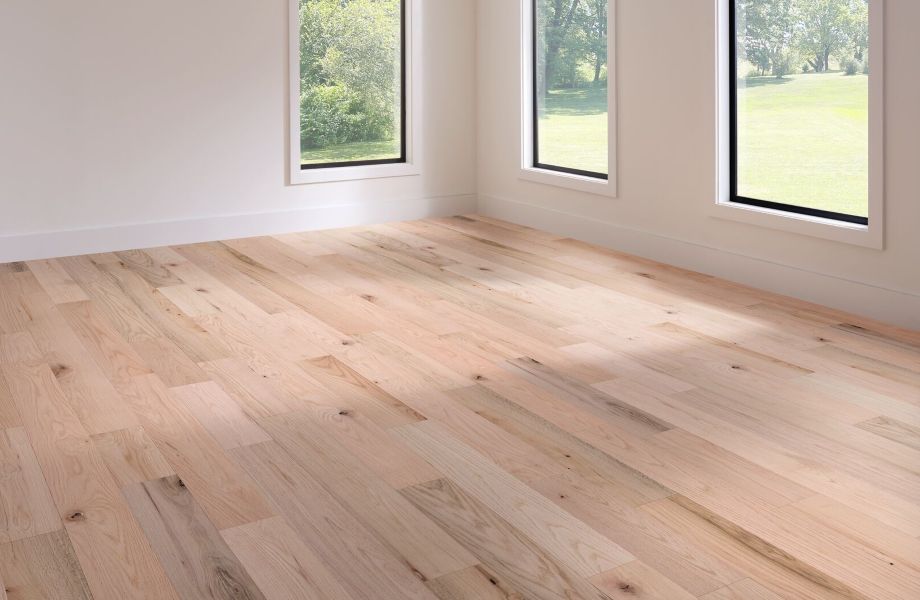
Acclimation is the process of allowing wood flooring to adjust to your home’s temperature and humidity before installation.
Hardwood works like a sponge. In humid conditions, it absorbs moisture and expands. In dry conditions, it releases moisture and shrinks. Installation doesn’t stop this behavior. It only hides it until damage becomes visible.
As the wood sits in its future environment, it naturally reaches equilibrium moisture content (EMC). In simple terms, it’s the point where the flooring’s internal moisture stabilizes to match the air around it.
“Acclimation is really about moisture balance, not just temperature. Wood responds to the water content in the air long before it reacts to heat or cold. When flooring is installed before that balance is reached, the wood continues adjusting after installation.” – Travis Bjorkman, Principal Scientist for Wood, AHF.
Why Acclimating Wood Floors Is Non-Negotiable
Scientists describe wood as hygroscopic, meaning it constantly absorbs and releases moisture from the air around it.
- When humidity rises, boards take on moisture and expand.
- When the air dries out, they release moisture and shrink.
Without acclimation, wood continues adjusting after installation. At that point, movement is no longer harmless; it becomes visible damage.
What Happens When You Skip Acclimation
When wood enters your home but doesn’t get to adjust to its moisture conditions, problems soon follow:
Gapping
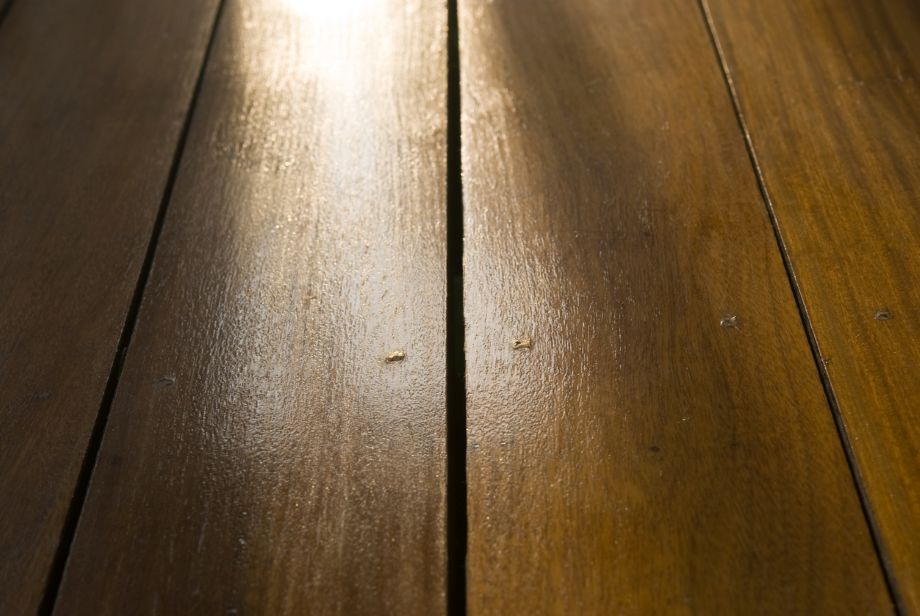
If the flooring dries out after installation, the boards shrink. That shrinkage creates visible spaces between planks.
Buckling and Crowning
If the flooring absorbs moisture after installation, it expands. When boards have nowhere to go, they lift upward, forming buckles and ridges.
Cupping and Warping
Excess moisture entering from below or through the air causes edges of boards to lift or curl. Left unchecked, the shape becomes permanent.
Loss of Structural Stability
Over time, improperly acclimated floors lose dimensional integrity. Once stability is compromised, repairs are costly and often incomplete.
Expensive Repairs
Damaged boards rarely reset themselves. Most failure scenarios require partial or complete replacement.
The Benefits of Allowing Wood Flooring to Acclimate
Acclimation is not about preventing problems alone. It is about ensuring the floor lives up to its full potential.
“Wood flooring responds to moisture long before homeowners can see it. Acclimation is the invisible insurance policy. Using a moisture meter and a hygrometer eliminates guesswork.”
– Travis Bjorkman, Principal Scientist for Wood, AHF.
Here’s what proper acclimation delivers:
- Cleaner installation: Boards fit together more securely and lie flatter.
- Greater stability: Seasonal movement is reduced.
- Better appearance: Fewer gaps, no warping, and smoother surfaces.
- Longer lifespan: Less internal stress on the wood over time.
- Warranty protection: Required by most manufacturers.
- Peace of mind: Fewer surprises after installation.
Why Flooring Sometimes Fails Even When Installation Was “Right”
Many homeowners believe that if a wood floor is installed correctly, its performance is guaranteed. It’s not.
The installation technique protects the structure. However, the acclimation process protects the material.
A professional installer can follow every instruction perfectly, but if they don’t allow them to balance with the home’s environment, movement is inevitable.
“Nearly every acclimation failure traces back to one assumption: that the house and the wood were close enough. Your home’s conditions must be ready for the installation. Wood responds to physics, not intentions.” – Travis Bjorkman, Principal Scientist for Wood, AHF.
Does All Flooring Need to Acclimate?
Yes. Even if not required by the manufacturer, it’s best practice to acclimate flooring to the space where you will install it.
What differs is how long acclimation takes, depending on the material.
Every floor reacts to its environment in some way. Natural wood responds to moisture. Synthetic planks react to temperature. Some materials change shape dramatically. Others move subtly.
But skipping the adjustment period creates unnecessary risk, regardless of the product you install.
The more organic the flooring, the longer acclimation typically takes.
Manufacturer instructions always take priority, but this table reflects how materials behave in real homes.
Does Engineered Hardwood Need to Acclimate?
Yes. As a best practice, engineered hardwood needs time to adjust before installation.
While engineered floors are more stable than solid hardwood, they are not immune to moisture and temperature changes. The surface layer is real wood and exchanges moisture with the air, just like any solid plank.
“Engineered hardwood may be more dimensionally stable than solid wood, but it is still wood. The top layer is real lumber and exchanges moisture with the environment, like any natural material. Even the flooring’s core includes wood products that can be impacted by moisture.” – Travis Bjorkman, Principal Scientist for Wood, AHF.
The difference is not whether engineered flooring needs acclimation, but how long it usually takes to acclimate.
How Engineered Hardwood Acclimates Differently
Because of its layered construction, engineered hardwood tends to adjust more gradually and with less movement than solid wood. However, the planks still need time to:
- Stabilize moisture content
- Equalize temperature
- Adjust to airflow patterns in the home
In many cases, engineered hardwood reaches EMC faster than solid wood.
Skipping acclimation entirely places unnecessary stress on the product from the moment you install it.
How Long Do Wood Floors Need to Acclimate?
There is no single number that applies to every home or every flooring product.
However, most hardwood floors require 3 to 10 days to acclimate before installation. The exact timeline depends on three things:
- Type of flooring
- Environment inside the home
- Species of wood
Acclimation is complete when the flooring’s moisture content matches the room and subfloor, not when a certain number of days has passed.
General Guidelines for Flooring Acclimation
Acclimation timelines often relate to days, but the reality is that proper acclimation depends more on environmental conditions than the calendar.
The timeframes below serve as general guidelines only. Actual acclimation varies based on factors such as indoor temperature, relative humidity, subfloor moisture levels, and how closely the home’s conditions match the flooring manufacturer’s recommendations.
In all cases, acclimation should be confirmed through moisture testing, not by elapsed time alone.
| Flooring Type | Estimated Time |
| Solid hardwood | 3-10 days |
| Engineered hardwood | 48–72 hours |
| Exotic species | Up to 14 days |
| Luxury vinyl | 24-72 hours |
| Laminate | 48 to 72 hours |
Note: These timeframes are general guidelines only. Always follow manufacturer instructions and confirm acclimation through appropriate moisture testing.
These ranges assume the home is already under normal living conditions. In very humid or very dry climates, or when storing flooring in uncontrolled conditions, the ranges may be longer.
How Do You Know When Your Wood Flooring is Acclimated?
Acclimation is complete only when the wood reaches moisture balance with your home. And yes, there’s genuinely a science around the process. Numbers, not estimates, confirm proper acclimation.
Here are three measurements that define the process.
1. Temperature
Your home should be consistently maintained between 60°F and 80°F. Those temperatures must reflect everyday living conditions. Intermittent heating or cooling does not count.
2. Relative Humidity
Indoor humidity should remain between 30% and 50% Relative Humidity. Brief swings happen. But if you fail to maintain moisture levels within the range, EMC cannot stabilize.
3. Moisture Content (MC)
For most hardwood floors in residential applications, the typical target moisture content is 6% to 9%. More important than the number itself is consistency with the subfloor.
Use a moisture meter to check the moisture content of the subfloor and wood planks. The moisture content should reach equilibrium, with readings close together.
Here’s a rule for matching moisture content:
- Wide planks > 3 inches: Within 2% of subfloor
- Narrow boards: Within 3% if conditions are stable
Wood is acclimated only when these readings remain steady over several days.
“Time alone does not determine acclimation. Moisture content does. Until readings stabilize, acclimation has not occurred.”
– Travis Bjorkman, Principal Scientist for Wood, AHF™.
How to Acclimate Wood Flooring the Right Way
Acclimation doesn’t begin when the boxes arrive. It starts when the home is ready. Rushing this step undermines everything that follows.
Acclimation Targets for Wood Floors
| Item | Target |
| Time | 3–10 days |
| Temperature | 60–80°F |
| Humidity | 30–50% |
| Moisture Content | 6–9% |
| Subfloor match | 2–3% |
| Packaging | Remove |
| Tool | Moisture meter |
Before the Flooring Arrives
Your home must resemble real living conditions before installing flooring in the space. So you must prepare the environment.
For 48 to 72 hours before delivery, stabilize your home:
- Keep the space enclosed
- Run your HVAC system continuously
- Keep the temperature between 60 and 80°F
- Maintain relative humidity between 30 and 50 percent
- Avoid active moisture from painting, drywall, or concrete work
If the room isn’t stable, your flooring won’t be.
Check the Subfloor
Before any wood arrives:
- Measure subfloor moisture
- Inspect for wetness or uneven conditions
- Correct problems before acclimation begins
The floor beneath the floor matters.
When the Flooring Arrives
Bring the flooring inside immediately, preferably in the space where you intend to install it. Don’t leave the flooring in a garage, on a porch, or in a warehouse space.
You or your contractor must stage the flooring in the room where you will install it.
Open the Packaging
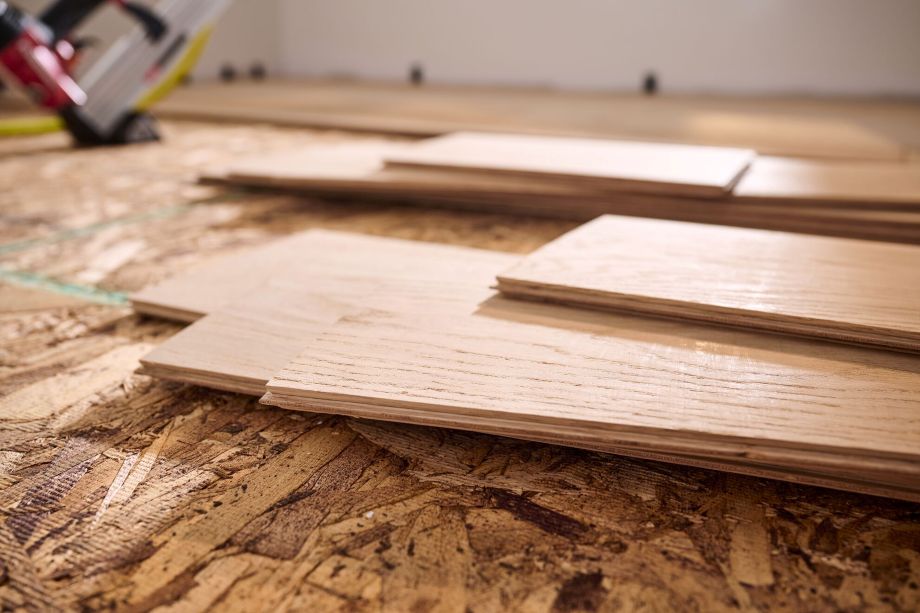
Wood can’t acclimate inside sealed packaging. Plastic traps moisture. Boxes prevent airflow.
At least, open each carton and remove any protective plastic. That will promote proper airflow and moisture exchange.
Even better, remove the planks and stack the flooring:
- Cross-stack planks in small piles
- Elevate the planks off the subfloor
- Position planks at least an inch apart
- Keep the planks away from exterior walls
The goal is to allow air to circulate on all sides of every plank.
How Seasons Affect Wood Flooring Acclimation
Acclimation isn’t only about installation day. It’s about preparing wood for the life it will live after installation.
Seasonal changes in humidity and temperature are the single most significant test of flooring stability. That’s where proper acclimation proves its value.
Summer: Expansion and Moisture Absorption
During warmer months, humidity rises, so the air holds more moisture. Wood takes it in.
When you fail to acclimate flooring before installation, summer conditions cause:
- Planks to swell
- Edges to rise (cupping)
- Boards to push against one another
- Buckling when expansion has nowhere to go
Wood that enters your home dry during humid weather will absorb moisture aggressively once installed. That’s why summer installations demand precise acclimation. Moisture imbalance shows up quickly when humidity is high.
Winter: Shrinkage and Dry Air
Winter creates the opposite problem. Heating systems dry indoor air. As humidity drops:
- Boards release moisture
- Planks contract
- Gaps appear between rows
- Cracks develop in extreme dryness
Wood installed before adjusting to winter conditions will continue to shrink long after the last board is fastened. Many floors that look flawless in October begin separating by January.
Protect Your Floors. Preserve Your Warranty.
Proper acclimation is the simplest way to protect your investment in hardwood flooring.
- It prevents damage.
- It improves performance.
- It keeps manufacturer warranties intact.
Bruce® designs hardwood floors to last. Proper acclimation ensures they perform that way.
If you have questions about preparation, installation, or care, Bruce provides installation instructions and a trusted network of retailers to help you get it right from day one.
Start with Bruce. Build with confidence.
FAQs: Acclimating Wood Floors
Does engineered hardwood need to acclimate?
As a best practice, yes. Engineered hardwood still contains real wood on the surface, and wood exchanges moisture with the air in your home.
While engineered floors are more stable than solid hardwood, they are not immune to environmental change. They still require time to adjust to temperature, humidity, and airflow before installation.
How long should hardwood floors acclimate before installation?
Most hardwood floors require 3 to 10 days under normal living conditions. Some may need longer depending on the climate, species, and construction stage. The key is for the flooring to stabilize to match the environment.
Can hardwood flooring acclimate while it’s still in the box?
No. Packaging prevents airflow and traps moisture. Plastic wrap seals in humidity and slows the adjustment process. Always open cartons, remove plastic, and cross-stack boards to allow air to circulate.
Is 24 hours enough to acclimate wood floors?
Usually not. Twenty-four hours are only enough for the flooring to reach room temperature. It does not allow the wood’s moisture levels to stabilize.
What happens if I skip acclimation and install anyway?
Skipping acclimation increases the risk of:
- Gaps between boards
- Buckling or lifting
- Cupping or crowning
- Cracks and warping
- Warranty denial
The floor may look fine at first. Many failures surface months later.
Do vinyl or laminate floors need to acclimate, too?
Yes, but for different reasons.
Vinyl responds to temperature. Laminate cores react to humidity. While they do not absorb moisture like wood, they still expand and contract. Acclimation reduces the risk of joint failure and shape distortion after installation.
Does acclimation take longer in humid or dry climates?
Yes. Extreme humidity slows moisture release. Arid air causes faster moisture loss. Both conditions require closer monitoring and potentially longer acclimation.