
How to Buy Flooring for the Way You Live
Published August 13, 2026 | Bruce® Flooring Expert
Somewhere between the showroom and the checkout, most flooring decisions get made backward. You fall for a color. You picture it in the living room. Then someone asks where it’s going and whether the dog’s nails will wreck it. Suddenly you’re back at square one holding a sample you can’t stop thinking about.
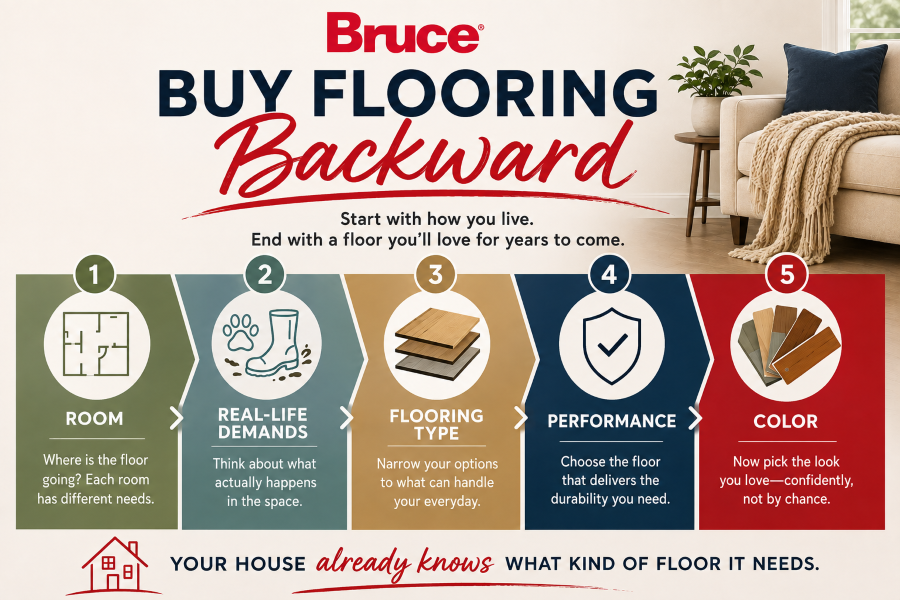
Start the other direction. Your house already knows what it needs. The mudroom that catches every snowmelt puddle. The kitchen where things get dropped. The bedroom nobody walks through in shoes. Each of those rooms is telling you something about what will hold up and what won’t.
Get that part right, and the color choice gets easy. It’s the last decision, not the first. For some added help, read how to prepare for a visit to a flooring retailer.
What Your Rooms Are Already Telling You
Walk through the space you’re planning to redo and pay attention to what actually happens there.
Is it above ground, on ground, or below? That single answer rules some products in and others out, because moisture behaves differently at every level. Is the subfloor wood or concrete? Does water show up regularly from a dishwasher, a laundry room, or kids coming in from the pool?
Then look at how the room is used, because “high traffic” isn’t the only problem. You face four concerns, and they wear down the floor in different ways.
Abrasion
Dog nails, grit tracked in on shoes, sand from the yard. They primarily present a surface-wear problem. The finish and surface construction determine how well a floor resists fine scratches and dulling over time.
Impact
A dropped skillet, a kid’s metal toy truck, the corner of a coffee table during a move. They present a dent problem. Material density, construction, and impact resistance all influence the extent of damage. Softer species and thin wear layers show it fastest.
Concentrated Loads
A rolling office chair that lives in one corner, a piano, a refrigerator on wheels. Weight on a small footprint behaves differently than weight spread across a room, and some products handle it poorly.
Moisture
Pet accidents that sit until someone notices, wet boots by the door, a plant that overflows. What matters is how long water can sit before it causes a problem, and whether the seams are protected.
Most busy households have all four, but rarely in equal measure. A house with two large dogs is facing wear and tear and accidents. A house with young kids is fighting impact and spills. Knowing which one dominates tells you which line in a spec sheet to read first.
Four Ways Everyday Life Wears Down a Floor
| Threat | Common causes | What to evaluate |
| Abrasion | Grit, dog nails, tracked-in sand | Finish and scratch resistance |
| Impact | Dropped cookware, toys, furniture | Density and dent resistance |
| Concentrated loads | Office chairs, pianos, appliances | Load and rolling-weight limits |
| Moisture | Spills, wet boots, pet accidents | Water protection and seam performance |
Pay Attention to Other Potential Concerns
And here’s the one people forget until it costs them. How much room do you have under the doors and dishwasher? Some floors sit taller than what you’re pulling out. Discovering that after delivery means trimming door bottoms or, worse, discovering the dishwasher won’t slide back in.
Room type also moves the budget. Kitchens, bathrooms, and basements generally cost more per square foot than bedrooms and living rooms. Items like waterproofing, moisture barriers, and slab prep all add labor before a single plank goes down.
Write down what each room demands. That list eliminates half the market before you’ve looked at a single sample. And that’s a good problem to have.
Real Wood, Wood-Look, or Real Wood Made Stronger?
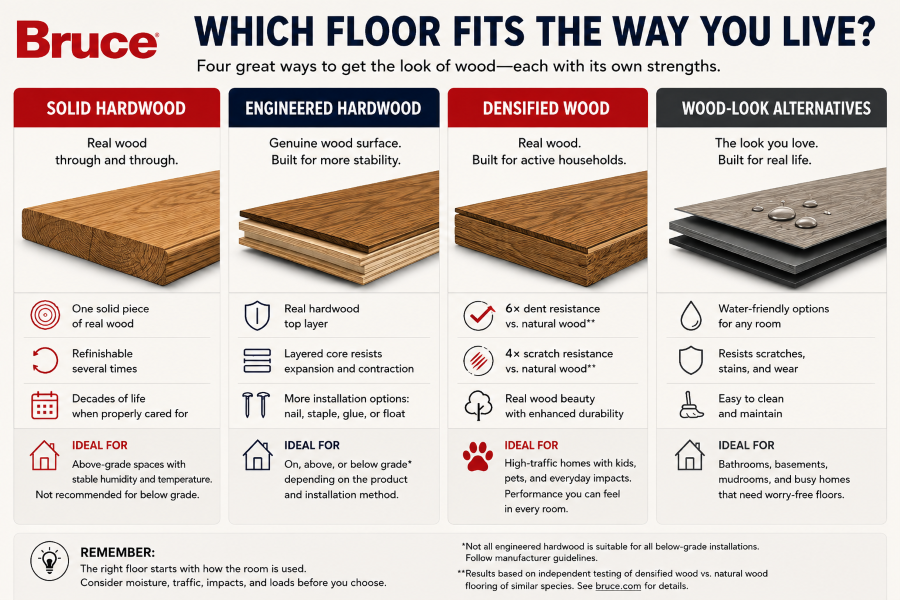
Most people shopping for flooring want wood. The real question is whether real wood, densified wood, or a wood-look alternative best fits the room.
Solid Hardwood
Solid hardwood is one piece of a tree, and it behaves like it. Natural character, decades of life, refinishable several times over. It also moves with humidity, so it’s happiest above grade in a house where the climate stays reasonably steady.
Engineered Hardwood
Engineered hardwood puts a genuine wood surface over a layered core: same real-wood face, but better dimensional stability. Plus, you have more installation options — nail, staple, glue, or float.
Depending on the product and installation method, engineered hardwood can go over concrete or below grade, where solid hardwood may not be recommended.
Densified Wood
Densified wood is the newer answer. It’s the one worth understanding if you love hardwood but doubt it can survive your household. For example, Bruce® Dogwood Pro uses heat and pressure to compress genuine hardwood into something considerably tougher.
The result is six times the dent resistance and four times the scratch resistance of standard engineered hardwood. It’s still real wood on top. You’re not trading the material for a photograph of it.
“Densified wood changes the conversation for homeowners who love hardwood but worry about dents and scratches. By strengthening real wood, we can preserve the authenticity people want while improving its ability to handle an active household.”
— Travis Bjorkman, Principal Scientist, Wood, AHF
Wood-Look Alternatives
Luxury vinyl plank, rigid-core, laminate, engineered stone tile, porcelain tile, and ceramic tile can recreate the appearance of natural materials through printed visuals, textures, and manufactured surfaces. Porcelain, ceramic, and engineered stone are especially worth considering in moisture-prone spaces where durability and easy cleaning matter.
Depending on the product, you may gain waterproof performance, scratch resistance, or easier maintenance. The trade-offs may include a firmer, colder surface, more complicated installation, and the loss of a genuine wood surface that can be refinished. For a basement, a laundry room, or a rental, that trade often makes complete sense.
There’s no universally correct answer here. There’s only the answer that meets your rooms’ demands and what you care about most.
Don’t Trust the Category Name
Two products can both be called waterproof and mean very different things. Same with pet-friendly, scratch-resistant, and kid-proof. The label is marketing shorthand; the specification sheet is the actual promise.
“Terms like waterproof and scratch-resistant describe how a product performed under a specific test, not a guarantee about every situation in your home. We test to defined conditions such as a set exposure time or a particular kind of abrasion. The warranty language tells you where those conditions end. Reading how a manufacturer defines its claim is more useful than comparing the claim itself.”
— Olga Rivas, Senior Research Scientist, AHF
Before you commit to anything, get answers to these:
| What to Check | What You’re Actually Asking |
| Water performance | Water-resistant or waterproof, and what voids the warranty? |
| Scratch resistance | Will it survive nails, grit, and furniture legs? |
| Dent resistance | What happens when something heavy hits it? |
| Grade level | Approved above, on, or below ground? |
| Subfloor | Wood, concrete, or over the existing floor? |
| Installation | Nail, staple, glue, grout, or float? |
| Maintenance | Which cleaners are approved, and which void the warranty? |
| Repairability | Can a damaged board be swapped? Can it be refinished? |
| Warranty | Covered for how long, and what is excluded? |
That last column matters more than it looks. A warranty that requires a specific cleaner isn’t unusual. But plenty of people find out about it the day they file a claim.
Color Is the Easy Part. Everything Else Is the Room.
Once you’ve narrowed to products that work, appearance finally gets to matter — and there’s more to it than the shade.
Plank Widths
Plank width changes how big a room reads. Wider planks, including widths of 7 inches or more, have become increasingly popular in main living areas because they show more of each board’s character.
Color
Color has moved too. The cool grays that dominated the previous decade have increasingly given way to natural oak, honey, and organic brown tones. If you plan to live with the floor for twenty years, consider whether an especially trend-driven color will still feel right as preferences change.
Gloss
Then there’s gloss. People treat it as a style decision when it’s really a maintenance decision. High-shine floors show everything: footprints, dust, the fine scratches that any floor collects. Matte and low-sheen finishes, and textured surfaces like wire-brushing, hide daily wear far better.
If your house runs busy, the finish you pick will do more for how the floor looks in year three than the color will.
Details
The rest is detail work. Beveled edges cast fine shadow lines between boards. Square edges read as a single continuous surface.
Then there’s variation. Real hardwood varies because every board came from a different part of a different tree, and a three-inch sample won’t show you the range. Printed wood-look products also have variation, but it repeats on a cycle.
Ask to see a full display so you can spot how often the same board comes back around.
Get Samples Into Your Actual House
Here’s the step people skip and regret.
Showroom lighting is designed to make flooring look good. Your kitchen at 4 p.m. in November is not designed to do that. A warm oak that glowed under retail fixtures can turn oddly gray next to your north-facing window and your particular cabinets.
So bring samples home and leave them there for a few days. Look at them in morning light and evening light. Set them against the trim, the cabinets, the couch. Stand up and look down at them the way you’ll actually see the floor, not held six inches from your face.
If you want to narrow things down before ordering samples, the Bruce Room Designer lets you upload a photo of your room and preview colors in the space. Useful for cutting a list of twelve down to three. Not a substitute for holding the real thing.
Buy More Than You Need
Flooring is priced by the square foot and sold by the carton. You need more square feet than your room contains.
Measure the length by the width for each space. Measure closets, hallways, and alcoves separately. Then add a waste allowance. Ten percent is the usual starting point for a straightforward plank layout.
Diagonal installations, busy patterns, stairs, and irregular rooms need more. Your installer can tell you what’s right for your job. A 12-by-15 room is 180 square feet. With a 10% allowance, you’re ordering 198 square feet and rounding up to whole cartons.
And if you have the space, keep one unopened carton after the install. Colors get discontinued. Locking systems get redesigned. Even a product still in the catalog can come from a different production run that doesn’t quite match.
The day a pipe leaks or you pull out a wall, that spare carton is worth considerably more than what you paid for it. Store it flat, indoors, and in a climate-controlled space, not the garage.
Price the Project, Not the Plank
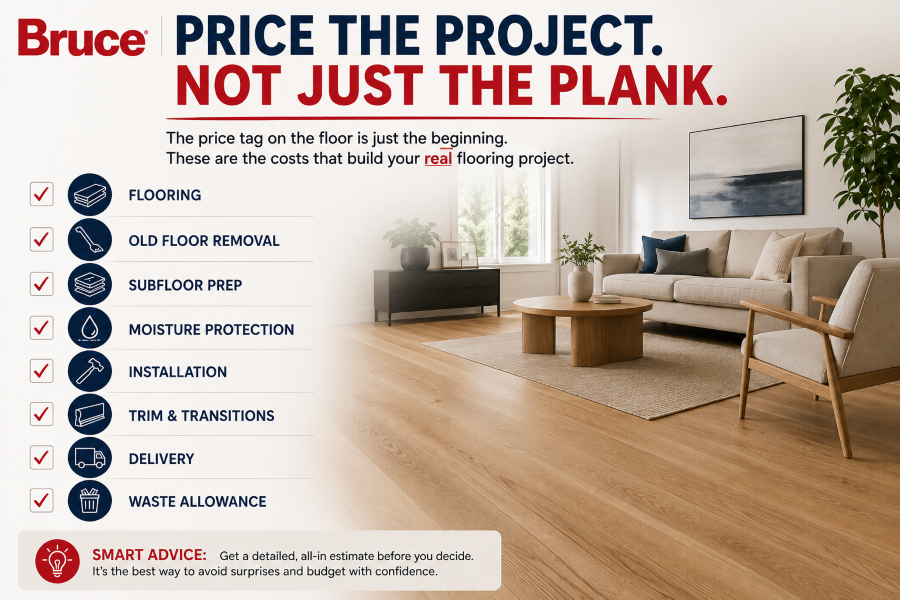
The per-square-foot number on the shelf tag is the starting point for the budget, not the total.
According to a 2026 USA TODAY analysis of flooring costs, installed flooring runs roughly $2.25 to $32 per square foot across all materials, including labor — carpet at the low end, natural stone at the high end. The analysis puts hardwood and engineered wood in the $6 to $22 range installed, with laminate at $4 to $10 and vinyl at $4 to $12. But remember, these are estimates.
That’s a wide band, and the width is the point. Material is only one part of the answer. Depending on the floor and condition of the space, labor and preparation can represent a substantial share of the total.
Why Flooring Labor Costs Vary So Much
USA TODAY’s reporting puts installation alone at $1.50 to $12 per square foot. What drives it isn’t the flooring so much as everything around it. How hard is the material to cut and fit? What’s coming out first? Is the subfloor flat, dry, and sound?
Labor also scales with where you live. Expect to pay above these ranges in a major metro or a high-cost-of-living state. For tile and stone, labor can exceed the cost of the material outright.
Tearing out the old floor is the classic budget surprise. Contractors interviewed by USA TODAY singled out tile removal in particular. Pulling up tile and the thinset underneath is slow, physical work. It has to be done properly, or a glue-down or floating floor won’t sit flat.
They also noted that rot in the subfloor near windows, doors, and bathrooms turns up often enough that it’s worth budgeting for before anyone knows it’s there.
Flooring Costs That Estimates Often Miss
Complex layouts with lots of cuts add labor. Then there’s a litany of other costs that often fall by the wayside when estimating a floor installation:
- Delivery
- Hauling away the old floor
- Moving furniture and appliances
- Subfloor repair
- Moisture testing
- Underlayment or moisture barriers
- Adhesive or fasteners
- Baseboards, trim, and transitions
- Stair parts
- Door adjustments
Bracket Your Budget
Measure your total square footage, add 10% for waste, then multiply by the low, high, and midpoint installed cost for the material you’re considering. That gives you a range, which is a more honest take on your budget. Then get itemized written estimates from at least three local contractors. Most quote for free.
Itemized matters. A bid that comes in low usually does so because something on the list above isn’t included, and you won’t find out which until the work starts.
And think past the invoice. A floor you can refinish twice has a different lifetime cost than one you’ll replace in twelve years, even if the cheaper one wins on day one.
Before You Sign Anything
Three things to settle before placing the order.
1. Who’s Installing the Flooring?
Floating floors with locking systems are the most DIY-friendly. But “friendly” still means subfloor prep, moisture testing, flattening low spots, undercutting door casings, holding expansion gaps, and staggering joints correctly. Solid hardwood, glue-downs, tile, and stairs are where most DIY projects go sideways.
It helps to know what you’re playing for. At $1.50 to $12 per square foot in labor, doing a 200-square-foot room yourself saves somewhere between a few hundred dollars and a couple thousand, depending on the product and your market. Weigh that against the cost of getting moisture, subfloor prep, or expansion space wrong. Those mistakes usually cost more to fix than the labor would have cost to hire.
If you’re hiring out, confirm that the installer knows the product and will provide a separate written installation warranty. Hiring a pro doesn’t automatically protect the manufacturer’s coverage.
Learn more about what to expect on installation day.
2. What Do the Instructions Require?
Read them before you buy, not after. They’ll tell you the approved grade levels, subfloor types, moisture limits, acclimation time, temperature and humidity ranges, radiant heat compatibility, and expansion requirements. If your house has a slab, radiant heat, or a history of moisture, here’s where you find out whether the product is actually a candidate.
3. What Does the Warranty Cover?
Flooring warranties protect against defined defects. They don’t promise your floor will look new forever.
Find out how long residential coverage lasts. Equally important, find out:
- Whether it’s prorated
- Whether labor is included
- Whether pets or rolling loads are excluded
- Whether professional installation is required
- Whether it transfers if you sell
Keep the receipt, the product name and color, the item number, the lot number, and a photo of the packaging.
One Last Thing: Check the Delivery
When the flooring arrives, open enough cartons to confirm that you received the correct product, color, quantity, and production lot. Look for visible damage and check that the color variation is what you expected.
Installing a floor generally counts as accepting how it looks. A concern that takes five minutes to raise beforehand takes a full tear-out to fix afterward, which is often not covered by a manufacturer’s warranty.
Where Flooring Purchases Go Wrong
- Choosing by color first and checking suitability second
- Putting a product in a room it isn’t approved for
- Assuming water-resistant means waterproof
- Comparing material prices instead of project costs
- Skipping subfloor inspection
- Ordering exactly the square footage with no waste allowance
- Buying connected rooms from different production lots
- Deciding from a showroom sample without seeing it at home
- Forgetting transitions, trims, and stair parts in the budget
- Hiring an installer without confirming experience with that product
- Throwing away every leftover board
Your Pre-Order Checklist
Before you place the order, you should be able to say yes to all of these:
- The flooring is approved for this room and grade level
- It handles the water and wear this space actually sees
- You’ve seen the sample in your own light, next to your own finishes
- The installation method works with your subfloor
- Your order includes a waste allowance
- Your estimate covers prep, accessories, and labor
- You’ve read the installation instructions
- You know what the warranty requires of you
- You’ve confirmed product, color, quantity, and lot
Make the Right Flooring Decision for Your Home
The best floor isn’t the most expensive one or the one with the boldest performance claim. It’s the one that looks the way you want while surviving what your house actually puts it through.
“The floors that hold up best are the ones chosen for the room they’re actually going into. We hear from homeowners years later about a floor that still looks right, and it’s almost never because they picked the most expensive option. It’s because they matched the product to how their household actually lives.”
— Devon McGrorty, Marketing Manager, AHF
Bruce has spent more than a century putting wood floors in busy, lived-in homes. That includes traditional solid hardwood and versatile engineered hardwood. It also includes more modern, densified wood for households that don’t slow down, and wood-look alternatives for rooms where wood isn’t the right answer.
Explore Bruce flooring, preview your favorites in the Room Designer, and take your samples home before you decide. You can find a local retailer here.
Frequently Asked Questions About Buying Flooring
What’s the first thing to consider when buying flooring?
The room. Grade level, moisture exposure, traffic, and subfloor determine which products are even candidates. Appearance and price come after.
How much does new flooring cost?
USA TODAY reports installed costs ranging from about $2.25 to $32 per square foot across all materials. Hardwood and engineered wood typically fall in the $6 to $22 range installed; laminate and vinyl run lower. But these are only estimates. Labor and preparation can account for a substantial share of the total, particularly for tile, stone, stairs, and rooms requiring extensive subfloor work. Get itemized estimates from local contractors rather than budgeting based on per-square-foot material prices.
Is labor more expensive than the flooring itself?
It can be. Labor costs depend on the flooring material, room layout, existing floor removal, and subfloor preparation. Tile, natural stone, stairs, and complex layouts generally require more labor than straightforward floating-floor installations. An itemized estimate will show how material and labor costs compare for your particular project.
Does flooring cost more in kitchens and bathrooms?
Generally yes. Moisture-prone rooms often need waterproofing and specialized underlayment. They’re also more likely to reveal subfloor damage during tear-out. Basements add slab prep, crack filling, and leveling.
What is the rule of three in flooring?
It’s a design guideline suggesting you limit a room to roughly three dominant wood tones. Your floor doesn’t need to match your cabinets or furniture exactly — an exact match often makes a room feel flat. Look for undertones that are compatible and have enough contrast to separate the surfaces.
How much extra flooring should I buy?
Ten percent above your measured square footage is the common starting point. Diagonal layouts, patterns, stairs, and irregular rooms need more. Confirm with your installer before ordering.
Should flooring be the same throughout the house?
Continuous flooring across connected spaces makes a home feel larger. But bathrooms, basements, and laundry rooms have moisture demands that may justify a different product.
Is it cheaper to install flooring myself?
It can be. It’s also where moisture, subfloor, and expansion-space mistakes turn into repairs and denied warranty claims. Weigh the labor savings against the difficulty of the specific product.
What’s the best flooring for a busy household?
It depends on what you value more: a genuine wood surface or maximum water resistance. Densified wood, luxury vinyl plank, rigid core, laminate, and engineered stone are all worth comparing for active homes.
When should I buy flooring?
Promotions come and go. Product suitability, lot consistency, and installer availability matter more than the calendar.