
How to Prepare for a Visit to a Flooring Dealer
Published August 20, 2026 | Bruce® Flooring Expert
When buying flooring, most people walk into a flooring showroom with a rough idea of the room and a color in mind. Ninety minutes later, they walk out with six samples, no quote, and a vague plan to come back once they’ve measured.
That trip wasn’t wasted, exactly. But it could have been one visit instead of three.
A flooring specialist can only make recommendations based on the information you provide. Give them measurements, photos, and a real sense of how the room gets used. Then, they can narrow four hundred products down to a handful before you’ve finished your coffee.
Show up with none of that and the conversation stays general, which is another way of saying it stays about color.
Whether you’re shopping for hardwood, luxury vinyl plank, laminate, or another type of flooring, preparing ahead helps your retailer recommend products that fit your home rather than simply matching a color.
Measure Before You Go
Square footage drives everything, including the estimate, the number of cartons, and which products land in your budget—guessing costs you a second visit.
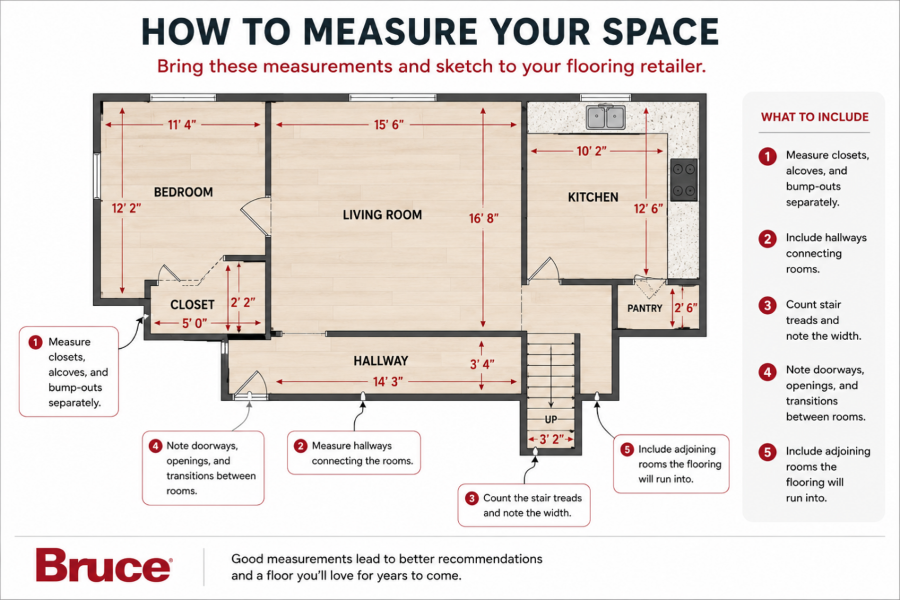
Take a tape measure to each space and write the numbers on paper or in your phone. Measure wall to wall, not just the open floor. Flooring usually runs under toe kicks and appliances.
For each room, record:
- Length and width
- Closets, alcoves, and any bump-outs, measured separately
- Hallways connecting the rooms
- Stairs — count the treads and note the width
- Adjoining rooms the flooring will run into
A quick sketch helps more than you’d expect. It doesn’t need to be to scale. A rough box with dimensions written on each wall tells a specialist what a spreadsheet can’t. For example, where the transitions land and whether the layout will drive the plank direction.
Most retailers will do a professional measure before final ordering, and yours may be free. But that usually happens after you’ve narrowed to a product. Your own numbers are what make the first conversation useful.
Worth asking when you get there: Is the measure free? Is it required before a firm quote can be provided? Does scheduling it commit you to anything?
Take Photos and a Video
Your phone is the most useful thing you’ll bring.
Get wide shots of each room from a couple of angles. Then get close-ups of the things the flooring has to live next to:
- Cabinets
- Countertops
- Trim and baseboards
- Stair parts
- Existing floor where it meets the room you’re changing
Two photos people forget:
- Transitions where one room meets another
- The gap under your doors and appliances
Both may affect what you can install.
Then shoot a slow thirty-second video walking through the space. A video shows how light moves through the room and how the spaces connect — things a still photo flattens out. It’s the single most useful thing you can hand a specialist, and almost nobody does it.
Bring the Things That Have to Match
Flooring gets chosen against a room, not in isolation. Bring the room with you as best you can:
- Paint chips or a swatch from the wall
- A cabinet door, or a photo taken in daylight if you can’t remove one
- A countertop sample or offcut
- Fabric from a sofa or chair that stays in the room
- A photo of window treatments
Undertones are the reason this matters. A warm oak next to a cool gray cabinet looks like a mistake even when both are beautiful on their own. A specialist can spot that clash in seconds if the samples are in front of them, and not at all if they aren’t.
Know What You Actually Have to Spend
Here’s the number that gets people in trouble: “I have $4,000.”
Four thousand for material, or four thousand for a finished floor? Those lead to completely different recommendations. Keep this in mind. Installation, subfloor preparation, trim, and accessories can represent a significant portion of the total project cost.
Say it this way instead: I’m trying to stay around $4,000 installed for these two rooms. Now the specialist can work backward, including material, labor, tear-out, prep, trim, and transitions, to show you products that actually fit.
Ask for the estimate broken out by line rather than as a single number. It makes it possible to compare two quotes and shows you where the money is going.
If your budget only works with a different material than you came in for, better to learn that in the first ten minutes than in the third visit.
Know How the Room Gets Used
You don’t need to have chosen a product, but you should be able to answer these without hesitating:
- Pets, and how many
- Large dogs with long nails specifically, as they change recommendations more than any other single factor.
- Kids, and how young
- Rolling office chairs, mobility equipment, or anything heavy on small wheels
- Direct sunlight, and how many hours
- Moisture concerns such as a slab, a basement, a bathroom, or a laundry room
- Whether shoes come off at the door
These answers do more to narrow the product list than anything else you’ll say. If you want to think it through in advance, our guide to buying flooring for the way you live walks through what heavy use actually does to a floor and which specifications to read first.
Come With Questions
The showroom conversation goes better when you’re driving it. These are worth asking about every product you’re seriously considering:
| Ask this | Because |
| Is it waterproof or water-resistant, and what’s the difference here? | The terms aren’t interchangeable, and warranties may define them differently.y |
| How does this hold up to pets and daily traffic, and what’s the wear layer or finish rated for? | The first half gets you a real answer; the second half keeps it specific |
| Is it approved for my subfloor and grade level? | Rules out products before you fall for them |
| How is it installed — nailed, glued, or floated? | Drives labor cost and timeline |
| Can a damaged board be replaced? Can it be refinished? | Determines the floor’s lifetime, not just its warranty |
| What cleaners are approved? | Using the wrong one can void coverage |
| What does the warranty exclude? | Pets, rolling loads, and moisture are common exclusions |
| Is professional installation required for the warranty to hold? | Changes the DIY math entirely |
| What’s the lead time, and is the color in stock? | Affects your whole schedule |
| Can I get all of it from one production lot? | Lots vary; connected rooms should match. |
Ten questions is a lot to remember. Write them down or pull them up on your phone.
Ask About Samples Before You Leave
You should not choose a floor from a showroom display alone. Lighting in a retail space is engineered to make flooring look good, and your kitchen in November is not.
Before you go, sort out the logistics:
- How many samples can you take?
- Is there a deposit, and how long can you keep them?
- Can you get a full plank rather than a small chip? Width and variation are hard to judge from a distance of three inches.
- Can you see a larger display or an installed floor somewhere?
Once you’re home, view each sample in morning, afternoon, and evening light before making a final decision. Lighting changes everything.
Take fewer samples than you’re tempted to. Three you’ll actually live with beats eight you’ll shuffle around the kitchen table.
Get the Installation Details in the Room
Installation is where timelines slip, and budgets grow. Ask now:
- Who moves the furniture and appliances, and is it included?
- Who removes and hauls away the old floor?
- Are transitions, trim, and moldings included in the estimate?
- Will the subfloor be inspected before the quote is final, and what happens if there’s a problem?
- Does the product need to acclimate in the house first, and for how long?
- How many days will the install take?
- Is there dust, and what’s the cleanup?
- When can we walk on it, and when can furniture go back?
- Does the installer carry a separate written installation warranty?
That last one matters. The installer’s own guarantee is what covers the work itself.
Walk Out of the Flooring Retailer With This
Before you leave, make sure you have:
- The full product name and collection
- The color name and item number
- A photo of each sample tag
- The quoted price per square foot, material and labor separate
- A written or emailed estimate
- How long the quote is good for
- The installation date, or an estimated scheduling window
- The specialist’s name and direct contact
- Lead time and whether the color is currently in stock
Photograph the tags even if you’re taking samples home. Samples can get separated from their labels, and “the medium brown one” is not a purchase order.
Your Pre-Visit Checklist
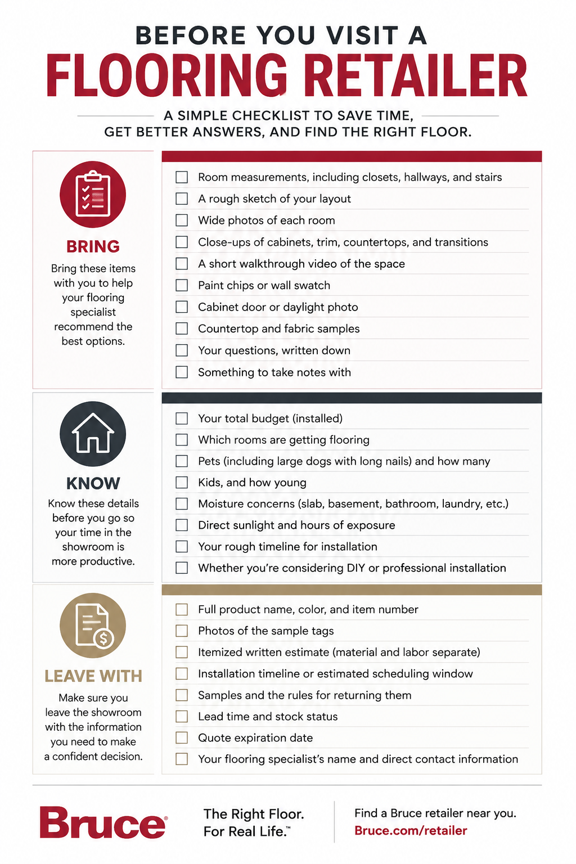
Print this, or pull it up on your phone at the door.
Bring:
- ☐ Room measurements, including closets, hallways, and stairs
- ☐ A rough sketch of the layout
- ☐ Wide photos of each room
- ☐ Close-ups of cabinets, trim, countertops, and transitions
- ☐ A short walkthrough video
- ☐ Paint chips or a wall swatch
- ☐ A cabinet door or daylight photo
- ☐ Countertop and fabric samples
- ☐ Your questions, written down
- ☐ Something to take notes with
Know:
- ☐ Your total budget, installed
- ☐ Which rooms are getting flooring
- ☐ Pets, kids, sunlight, moisture, heavy use
- ☐ Your rough timeline
- ☐ Whether you’re considering DIY
Leave with:
- ☐ Product name, color, and item number
- ☐ Photos of the sample tags
- ☐ An itemized written estimate
- ☐ Quote expiration date
- ☐ Installation date or scheduling window
- ☐ Samples and the rules for returning them
- ☐ Lead time and stock status
- ☐ Your specialist’s contact information
One Visit Instead of Three
None of this takes long. An hour with a tape measure and a phone is most of it.
What it buys you is a conversation that starts at the useful part. Instead of explaining your house, you’re comparing three products that already fit it. You leave with a quote you can actually think about rather than a promise to come back.
Find a Bruce® retailer near you, bring your checklist, and start the conversation with confidence!
Frequently Asked Questions About A Flooring Showroom Visit
What should I bring to a flooring showroom?
Room measurements, including closets and hallways; a rough sketch; photos; and a short video of each space. Include paint chips, a cabinet door or countertop sample for color matching. Add your installed budget and a written list of questions.
Do I need measurements before getting a flooring estimate?
For a rough estimate, yes. Your own measurements are enough to get useful recommendations and a ballpark price. A firm quote usually requires a professional measure, which most retailers perform after you’ve narrowed to a product.
Can I get a flooring estimate without visiting the store?
Some flooring retailers can provide a preliminary estimate from room measurements and photos. But a showroom visit allows you to compare products, discuss installation requirements, and receive more accurate recommendations. Most final quotes require a professional in-home measurement.
Should I bring paint colors when shopping for flooring?
Yes. Undertone clashes between flooring and wall color or cabinets are hard to spot from memory and obvious when the samples sit side by side.
What questions should I ask a flooring retailer?
Cover water performance, durability and wear ratings, subfloor and grade approval, installation method, repairability, approved cleaners, warranty exclusions, whether professional installation is required, lead time, and production lot consistency.
Can I take flooring samples home?
Most flooring retailers allow it. Ask how many you can take, whether there’s a deposit, how long you can keep them, and whether a full plank is available instead of a small chip. View each sample in morning, afternoon, and evening light before deciding.
How long does a flooring consultation take?
Plan on an hour for a first visit if you come prepared. Arriving without measurements or photos usually turns one visit into two or three.
Do flooring stores provide installation estimates?
Most do, though a firm number typically follows a professional measure and subfloor inspection. Ask for an itemized estimate so material, labor, tear-out, transitions, and accessories are visible separately.
What’s the best time to shop for flooring?
Weekday mornings tend to be quietest, which means more time with a specialist. Beyond that, product suitability and installer availability matter more than the calendar.