
Hardwood Flooring: The Definitive Source for Homeowners
April 10, 2026 | By Bruce® Flooring Experts
Hardwood flooring isn’t simply a design choice. It’s one of the most enduring structural and aesthetic investments a homeowner can make.
Few materials used in residential construction today can trace their origins back centuries and still dominate modern interiors.
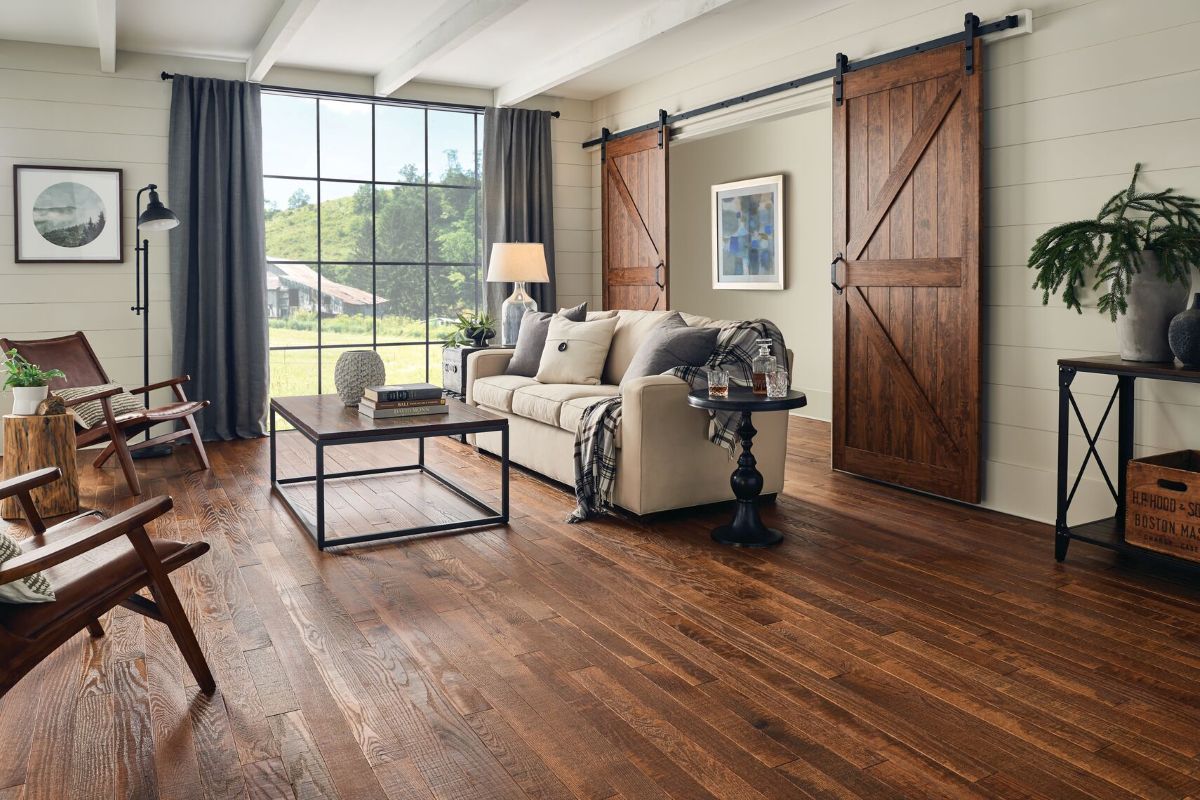
Distressed solid oak flooring creates a rustic, lived-in appeal by adding imperfections like scratches, dents, and wire-brushed textures to new wood planks.
Key Takeaways
- Hardwood flooring remains the benchmark for durability, longevity, and resale value.
- Solid and engineered hardwood serve different structural and environmental needs.
- Densified hardwood enhances surface dent resistance while preserving natural wood.
- Species selection influences both performance and visual character.
- The Janka hardness scale provides a standardized way to compare dent resistance.
- Finish texture and sheen significantly affect design impact and maintenance.
- Proper installation and humidity control determine long-term stability.
- Waterproof wood-look alternatives extend hardwood aesthetics into high-moisture areas.
Hardwood flooring is a natural wood floor made from solid lumber or engineered wood layers with a real hardwood surface. Known for durability, longevity, and timeless design, hardwood floors can last for decades, and some may be refinished multiple times over their lifespan.
Modern hardwood flooring includes solid hardwood, engineered hardwood, and performance-enhanced options such as densified wood, each designed to address different installation environments and durability needs.
When Was Hardwood Flooring Introduced?
Wood plank flooring began appearing in European homes in the 1600s. Early installations were practical rather than decorative, consisting of unfinished planks laid for durability and insulation.
As craftsmanship advanced, decorative parquet patterns emerged in wealthier homes during the 18th and 19th centuries. In America, settlers relied on abundant native hardwoods, installing wide planks that were often of varying widths and sanded smooth over time.
By the late 1800s and early 1900s, industrial milling changed the trajectory of hardwood flooring. Standardized board widths and tongue-and-groove construction made installation more efficient and more accessible. Wood flooring shifted from custom craftsmanship to a mainstream residential material.
The 20th century introduced competition. Cork and linoleum gained traction in the 1920s. Wall-to-wall carpeting surged after World War II. For a time, hardwood fell out of favor.
But it never disappeared.
The Resurgence of Hardwood Flooring in the 1980s
Beginning in the 1980s, homeowners returned to natural materials and long-term value. Hardwood flooring experienced a resurgence that continues today.
Advances in engineered construction improved dimensional stability. Factory-applied finishes enhance durability and consistency. Modern milling techniques have increased precision and installation efficiency. More recently, performance-enhancing technologies have further expanded hardwood’s versatility.
For more than a century, real wood floors have defined living rooms, dining rooms, hallways, and bedrooms across the United States. While other flooring materials have risen and fallen with design trends, hardwood has remained constant. It adapts. It ages. It evolves. And when properly maintained, it can last for generations.
For more details on the manufacturing process, read How Wood Flooring is Made – From Forest to Lumber.
Hardwood Flooring’s Enduring Popularity Today
History explains hardwood’s origins. Market data explains its staying power.
Beyond performance, homeowners consistently cite the emotional and sensory qualities of real wood as a primary reason for choosing hardwood. In national surveys, nearly 70% of homeowners describe wood floors as highly attractive, and roughly two-thirds say they would select hardwood for their dream home (Source: Floor Daily).
No synthetic alternative fully replicates the warmth, texture, and natural variation of real wood. Grain movement, subtle tonal shifts, and organic depth create a visual character that printed or embossed surfaces struggle to match.
That emotional preference translates directly into sustained global demand.
Global Market Growth Reflects Continued Demand
According to Fortune Business Insights, the global wood flooring market was valued at approximately USD 33.3 billion in 2019 and is projected to reach USD 41.7 billion by 2027, representing a compound annual growth rate of 3.6 percent.
Asia Pacific currently represents the largest share of the global market, accounting for nearly 59 percent in 2019. Meanwhile, the U.S. wood flooring market alone is projected to approach USD 3.6 billion by 2027, supported by residential renovation activity and commercial space upgrades.
Steady growth over multiple economic cycles suggests that hardwood flooring is not a short-term trend. It is a mature category supported by consistent demand from homeowners.
5 Things to Look for in Hardwood Flooring
Choosing hardwood flooring involves more than selecting a color or plank width. Long-term performance depends on understanding a few key characteristics before making a decision.
To make selection easier, read Hardwood Flooring Checklist – Be Ready Before You Buy.
- Construction
Solid hardwood is milled from a single piece of lumber and offers maximum refinishing potential over its lifetime. Engineered hardwood features a layered construction that improves dimensional stability, making it better suited for concrete subfloors and climates with seasonal humidity swings. - Species and Hardness
Wood density influences dent resistance and durability. The Janka hardness scale provides a standardized way to compare species such as oak, maple, hickory, and walnut. Harder species typically perform better in high-traffic areas. - Veneer Thickness
For engineered hardwood, the thickness of the hardwood veneer affects longevity. A thicker veneer allows for refinishing and extends the floor’s usable life. - Finish and Surface Texture
Matte and wire-brushed finishes tend to conceal scratches and everyday wear more effectively than high-gloss surfaces. Modern factory-applied finishes can further enhance scratch resistance and durability. - Moisture Considerations
Hardwood performs best in controlled indoor environments. Engineered construction generally offers greater stability in moisture-prone or humidity-variable conditions.
Understanding these fundamentals makes it easier to select the right type of hardwood flooring for your home.
Types of Hardwood Flooring
| Type | Construction | Best For | Key Benefit |
| Solid Hardwood | Single piece of wood | Above-grade rooms | Maximum refinishing potential |
| Engineered Hardwood | Hardwood veneer over a layered core | Basements, slabs, humidity swings | Greater dimensional stability |
| Densified Hardwood | Compressed hardwood fibers | Homes with pets and kids | Increased dent resistance |
| Wood-Look Alternatives | Vinyl, laminate, porcelain | Moisture-prone spaces | Waterproof durability |
What Types of Hardwood Flooring Are Available?
Modern hardwood flooring isn’t a single product category. It includes several construction methods designed to address different environments, performance expectations, and installation conditions.
At its core, every hardwood floor features real wood at the surface. The differences lie in how that wood is structured and how it behaves once installed.
Understanding these distinctions allows homeowners to select the type of wood flooring that aligns with both design goals and practical realities.
What Is Solid Hardwood Flooring?
Solid hardwood flooring is milled from a single piece of lumber. Each plank is one continuous layer of natural wood from top to bottom. This traditional construction has been used in homes for more than a century and remains a benchmark for longevity.
Because the entire thickness is hardwood, solid planks can typically be sanded and refinished multiple times over their lifespan. That refinishing potential is one of the primary reasons solid hardwood is associated with generational durability. In stable indoor environments, solid wood floors can last 75 years or more.
When Is Solid Hardwood the Right Choice?
Homeowners select solid hardwood when prioritizing long-term value and the ability to restore rather than replace. It performs best above grade, installed over wood subfloors, in homes with relatively consistent indoor humidity year-round.
For those building or renovating in controlled environments, solid hardwood offers unmatched refinishing flexibility and enduring appeal.
What Should You Consider Before Choosing Solid Hardwood?
Solid hardwood responds directly to changes in moisture. Seasonal expansion and contraction are natural characteristics of the material. Proper acclimation and installation techniques account for that movement, but environments with significant humidity fluctuation may require a more stable construction approach.
Take a deeper dive by reading Why Choose Solid Wood Flooring.
Understanding how your home’s climate behaves is essential when selecting solid wood.
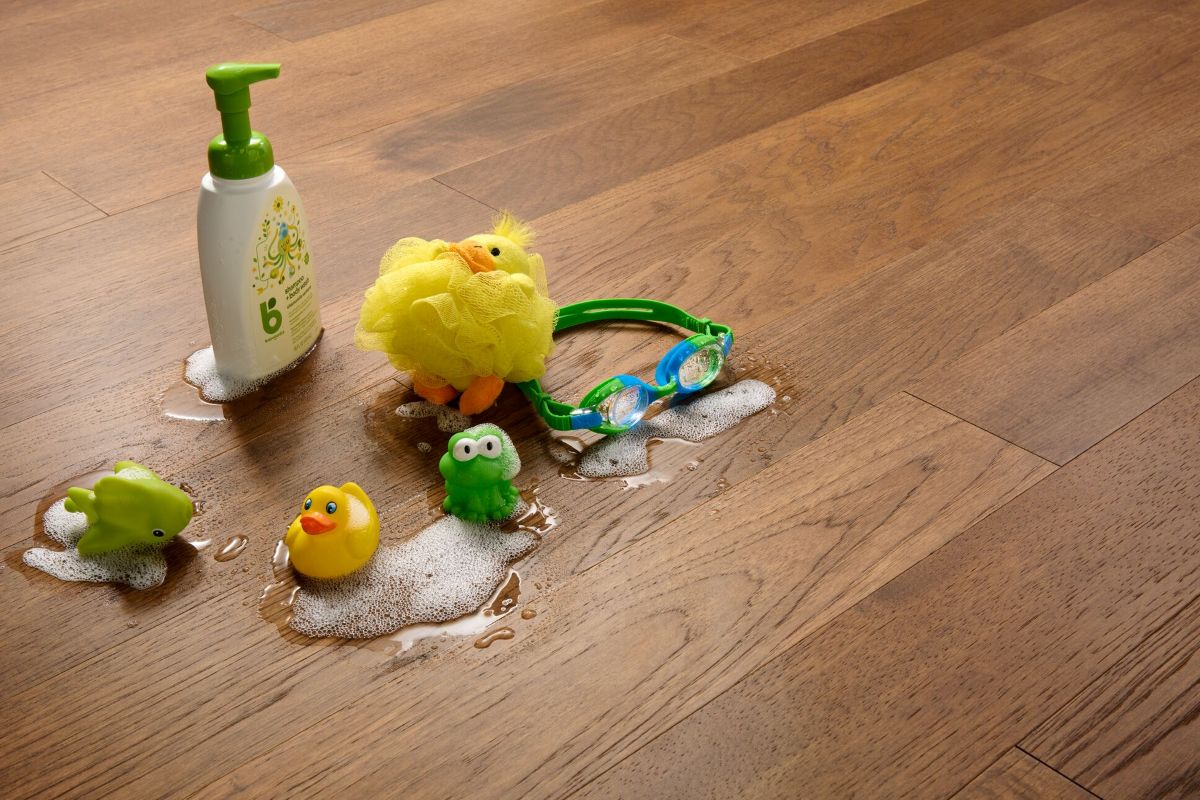
The cross-layer design of engineered hardwood improves dimensional stability by moderating the floor’s response to humidity changes. That improves its water resistance vs. solid hardwoods.
What Is Engineered Hardwood Flooring?
Engineered hardwood flooring features a real hardwood veneer bonded to a multi-layer core. Unlike solid hardwood, which consists of a single layer of wood, engineered construction arranges interior layers in alternating grain directions. This cross-layer design improves dimensional stability by moderating the floor’s response to humidity changes.
“Wood movement cannot be eliminated, only managed. Engineered construction helps regulate that movement more predictably.”
— Travis Bjorkman, Principal Scientist for Wood, AHF
The visible surface of engineered hardwood is genuine wood. It can be oak, maple, hickory, walnut, or other species. The difference lies beneath the surface, where structural layering enhances stability.
When Is Engineered Hardwood the Right Choice?
Homeowners often choose engineered hardwood when installation conditions are less predictable. It’s frequently installed over concrete subfloors, in below-grade spaces, or in climates with greater seasonal humidity swings.
Engineered construction also makes wider plank formats more feasible, as the layered core helps control expansion across the board’s width.
For many modern homes, engineered hardwood offers a balance between authenticity and environmental adaptability.
Discover which type of hardwood flooring is better for your home: engineered or solid.
What Should You Consider Before Choosing Engineered Hardwood?
Veneer thickness plays an important role in long-term performance. Thicker veneers may allow for future refinishing. At the same time, thinner veneers limit restoration potential—construction quality and the durability of the finish system further influence the floor’s performance over time.
Evaluating both the visible surface and the underlying structure ensures engineered hardwood delivers the lifespan you expect.
What Is Densified or Hardened Hardwood?
Densified hardwood, sometimes referred to as hardened wood, represents a more recent advancement in hardwood performance. For example, Bruce® introduced Dogwood Pro™, a revolutionary engineered hardwood that substantially improves hardwood performance.
Through controlled heat and pressure, the wood’s cellular structure is compressed, increasing surface hardness without altering the natural grain pattern. The result is real hardwood with improved resistance to dents and surface impact.
- 6x the dent resistance
- 4x the scratch resistance
- Waterproof protection for up to 8 hours
The flooring also includes an antimicrobial coating to protect against bacteria, mold, and mildew that may damage the floor.
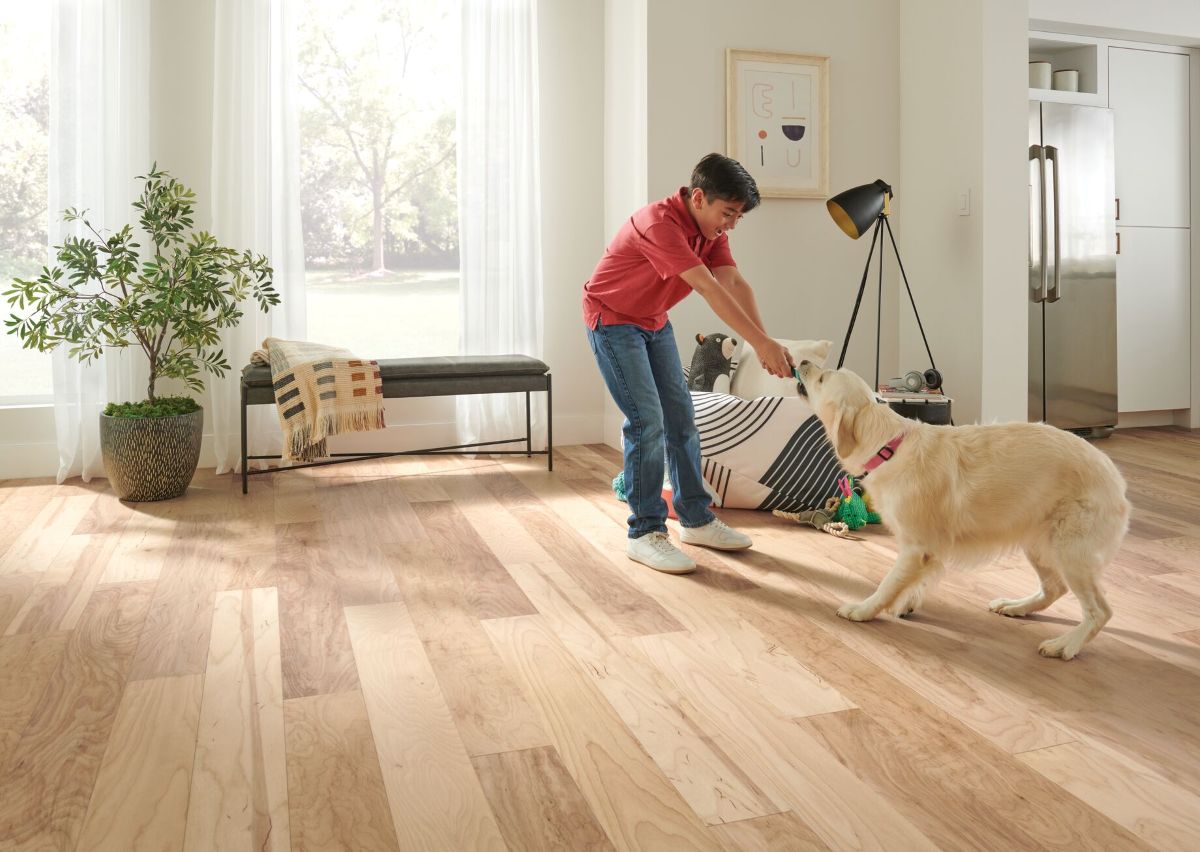
Made from densified wood, Dogwood Pro™ handles heavy household traffic from kids and pets. It’s six times more dent-resistant and four times more scratch-resistant than standard engineered hardwoods.
Dog-Friendly Flooring That Handles Kids and Pets
Pets, children, and high foot traffic can challenge traditional wood surfaces. Densified hardwood strengthens the top layer while preserving the warmth and authenticity that define real wood.
For homeowners who want the aesthetic appeal and refinishing potential of hardwood but need added resilience, densified wood represents a performance-forward evolution of the category.
Learn why hardened wood flooring is the new standard for hardwood floors.
What are the Best Wood-Look Flooring Options?
There are environments where natural hardwood may not be the ideal solution. Areas with persistent moisture exposure, such as certain basements or full bathrooms, can exceed wood’s natural tolerance.
In those spaces, fully waterproof materials such as luxury vinyl tile, laminate flooring, rigid core vinyl, or wood-look porcelain tile may be more appropriate. These products replicate the visual appearance of hardwood while offering increased resistance to standing water.
Choosing an alternative doesn’t diminish the hardwood’s value. Instead, it reflects thoughtful material selection in response to environmental demands.
Hardwood remains the benchmark for authenticity, longevity, and refinishing capability. Alternatives extend the visual language of wood into spaces with a higher risk of moisture.
How Should You Choose a Hardwood Species?
Selecting a hardwood species involves balancing performance needs with design preference.
Foot traffic levels, the presence of pets, and daily activity all influence the amount of dent resistance you may need.
Grain visibility and natural variation determine whether the floor feels subtle and uniform or bold and expressive. Undertones affect how the flooring interacts with cabinetry, wall color, and lighting.
The Right Species Aligns with How You Live
Because hardwood is a natural material, color shifts and grain movement are inherent characteristics rather than defects. Some species, such as hickory, display dramatic contrast, while others, like maple, offer a smoother, more consistent appearance.
“The Janka rating measures dent resistance. Construction method and finish system are just as important in real-world performance.”
— Travis Bjorkman, Principal Scientist for Wood, AHF
Hardness is only one part of the equation. Finish durability, plank construction, subfloor stability, and moisture control all contribute to long-term performance.
The right species is not simply the hardest wood available. It is the one that aligns with how you live and how you want your space to feel.
What Are the Most Common Wood Species for Hardwood Flooring?
Wood species influence three primary characteristics:
- Hardness and dent resistance
- Grain pattern and visual movement
- Natural color tone and aging behavior
Different species perform differently under daily wear, and each creates a distinct design statement.
Below are the most commonly used hardwood flooring species in North America.
Common Hardwood Flooring Species Comparison
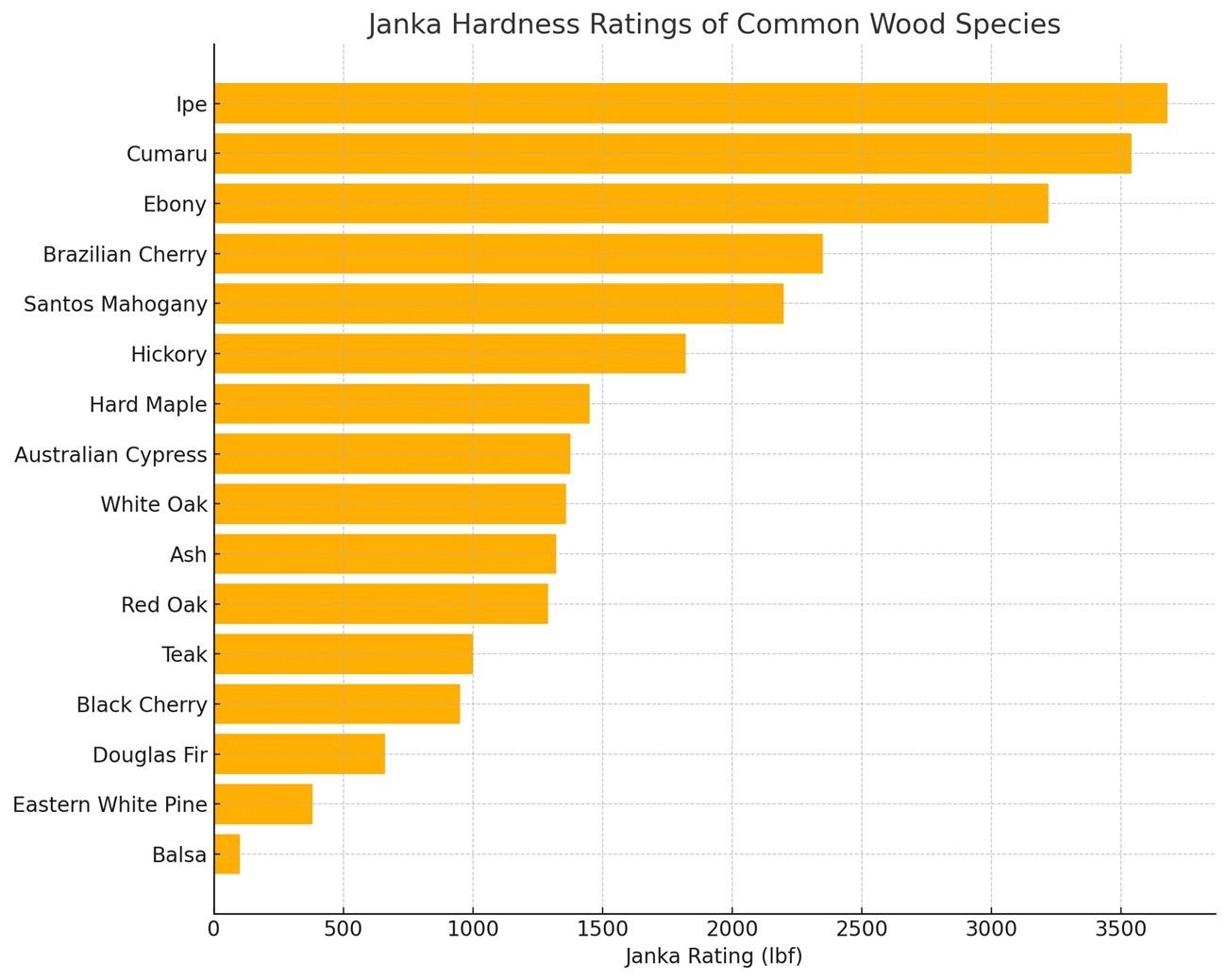
| Species | Approx. Janka Rating | Grain Pattern | Natural Color Range | Best For |
| Red Oak | 1290 | Prominent, open grain | Warm pink to light brown | Traditional homes, balanced durability |
| White Oak | 1360 | Straighter, tighter | Beige to light brown | Modern and transitional spaces |
| Maple | 1450 | Subtle, smooth | Creamy light tones | Contemporary interiors, high traffic |
| Hickory | 1820 | Bold, high variation | Light to dark contrast | Active households, rustic aesthetics |
| Walnut | 1010 | Smooth, refined | Rich brown tones | Formal spaces, lower traffic areas |
| Cherry | 950 | Fine, straight | Reddish brown, deepens | Classic interiors, low traffic |
What is the Janka Hardness Rating?
The Janka hardness rating measures resistance to denting under controlled testing conditions. Higher numbers generally indicate greater dent resistance.
However, hardness is not the only performance factor. Finish durability, plank construction, and environmental conditions also influence long-term wear.
For example:
- Hickory flooring offers exceptional dent resistance and features dramatic color variation, making it ideal for active households and rustic aesthetics.
- Oak flooring offers balanced durability, versatile grain patterns, and neutral undertones that work in both traditional and modern interiors.
- Maple flooring delivers a smooth, refined appearance with higher natural density, making it well-suited for contemporary spaces and high-traffic areas.
Homeowners comparing species often look more closely at the differences between red and white oak, or weigh maple vs oak hardwood flooring, to better understand grain visibility, hardness, and long-term wear characteristics.
Should You Choose Prefinished or Site-Finished Hardwood?
Once you’ve selected a species and construction type, the next decision is how to finish the floor.
Hardwood flooring can arrive with a factory-applied finish or be sanded and sealed after installation. Each approach offers distinct advantages depending on project goals and timeline.
What Is Prefinished Hardwood Flooring?
Prefinished hardwood is coated at the manufacturing facility before it reaches the job site. The finish is applied in controlled conditions and cured using advanced processes such as ultraviolet (UV) technology.
Because the finish is factory applied, prefinished hardwood is ready for light foot traffic shortly after installation.
Why Do Homeowners Choose Prefinished Hardwood?
Prefinished flooring offers convenience and consistency. Factory-controlled environments allow for precise application of protective coatings, often incorporating aluminum oxide or similar durability-enhancing materials.
Advantages include:
- Faster installation and reduced downtime
- No sanding dust inside the home
- Consistent finish quality
- Strong scratch resistance
For many homeowners, prefinished hardwood offers a predictable, efficient installation experience.
For a deeper look at how factory finishes are applied and what makes them durable, explore our guide to prefinished hardwood flooring.
What Is Site-Finished Hardwood?
Site-finished wood is installed as unfinished hardwood planks, then sanded, stained, and sealed.
This process allows for greater customization of color and sheen. It can also create a smoother surface because the entire floor is sanded as a single, continuous plane.
Why Do Homeowners Choose Site-Finished Hardwood?
Site-finishing offers flexibility.
It allows homeowners to:
- Custom-blend stain colors
- Adjust sheen levels precisely
- Create a uniform look across rooms
However, the process requires additional time for sanding, finishing, and curing. It also introduces temporary dust and odors during application.
Where Should You Install Hardwood Flooring in Your Home?
Hardwood flooring works well in living rooms, bedrooms, dining rooms, and hallways. Engineered hardwood performs better in kitchens and basements due to improved moisture stability, while waterproof wood-look flooring is typically recommended for bathrooms.
Hardwood Flooring Room Guide
| Room | Recommended Flooring | Why |
| Living Room | Solid or Engineered Hardwood | High design impact and durability |
| Dining Room | Solid Hardwood | Elegant, long lifespan |
| Bedrooms | Solid or Engineered Hardwood | Warm, comfortable underfoot |
| Kitchen | Engineered Hardwood | Better moisture stability |
| Hallways | Harder species (Oak, Hickory) | Handles heavy foot traffic |
| Home Office | Solid Hardwood | Durable and visually refined |
| Basement | Engineered Hardwood or Wood-Look Flooring | Handles moisture conditions |
| Bathroom | Wood-Look Alternatives | Waterproof protection |
How Do You Design with Hardwood Flooring?
Designing with hardwood flooring requires balancing aesthetics with function. Species, plank dimensions, color tone, and finish all influence how a space feels and performs over time.
Hardwood is not just a surface. It anchors the room’s visual foundation. For an in-depth look, read How to Design a Space Around Hardwood Flooring.
How Does Floor Color Affect a Room?
Color is often the first design decision homeowners make.
Light-toned floors create an airy, open atmosphere. They reflect more natural light and can make smaller rooms feel larger. Light oak and maple are commonly used in contemporary interiors for this reason.
Medium tones offer versatility. They balance warmth and brightness, working well across transitional designs.
Dark floors create contrast and visual drama. They can feel formal and grounded but may show dust and scratches more readily than lighter options.
As a general design principle, flooring should either contrast with wall color or be noticeably darker to anchor the space.
Does Plank Width Change the Look of a Room?
Yes, significantly.
Wider planks (typically 5 inches or more) create a modern, expansive look. Fewer seams make the space feel more seamless and open.
Narrower planks (2 to 4 inches) produce a more traditional aesthetic with greater visual rhythm.
Longer board lengths also contribute to a cohesive appearance, reducing the “choppy” look created by frequent end joints.
The plank scale should align with the room size. Large-format planks tend to work best in open layouts, while narrower boards can complement smaller or more traditional spaces.
How Do Texture and Sheen Influence Design?
Surface texture changes how hardwood interacts with light and wear.
Wire-brushed, hand-scraped, or lightly textured surfaces emphasize natural grain and help disguise minor scratches. Smooth finishes create a cleaner, more formal appearance.
Sheen level also matters.
Matte and satin finishes reduce reflectivity and conceal everyday wear more effectively than high-gloss surfaces. High-gloss finishes create dramatic shine but reveal imperfections more easily.
For active households, lower-sheen finishes often offer the best balance of design and practicality.
How Should Hardwood Flow Between Rooms?
Consistency creates cohesion.
Using the same hardwood throughout open-concept spaces can make a home feel larger and more unified. Transitions between materials should be intentional and used only when necessary, based on function or moisture considerations.
Board direction also affects perception. Installing planks parallel to the longest wall or toward the primary light source can enhance visual flow.
How Do You Balance Design and Durability?
Design decisions should reflect how you use your home.
A family room with pets may benefit from a harder species and a lower-sheen finish. A formal dining room may prioritize visual elegance over maximum dent resistance.
Hardwood performs best when aesthetic goals align with lifestyle realities.
How Much Does Hardwood Flooring Cost?
According to national cost data from Angi, hardwood flooring installation costs vary based on construction type, material grade, and regional labor rates. The ranges below reflect estimated national averages for full installation, including materials and labor.
Average Hardwood Flooring Installation Costs
| Flooring Type | Estimated Installed Cost (Per Sq. Ft.) |
| Solid Hardwood | $10–$28 |
| Engineered Hardwood | $7–$20 |
Source: Angi Cost Guide, “How Much Does Hardwood Flooring Cost?” 2025 national averages. These figures represent national averages and may vary based on region, subfloor preparation, removal of existing flooring, and layout complexity.
For a 500-square-foot space, total installed costs typically range from $3,000 to $12,500, depending on material selection and project complexity.
How to Install Hardwood Flooring
Proper installation plays a critical role in how hardwood flooring performs over time. Because wood naturally expands and contracts with changes in humidity, installation methods are designed to allow controlled movement while maintaining structural stability.
The specific installation approach depends on the flooring construction type and the subfloor beneath it. Preparation is the key to a smooth installation.
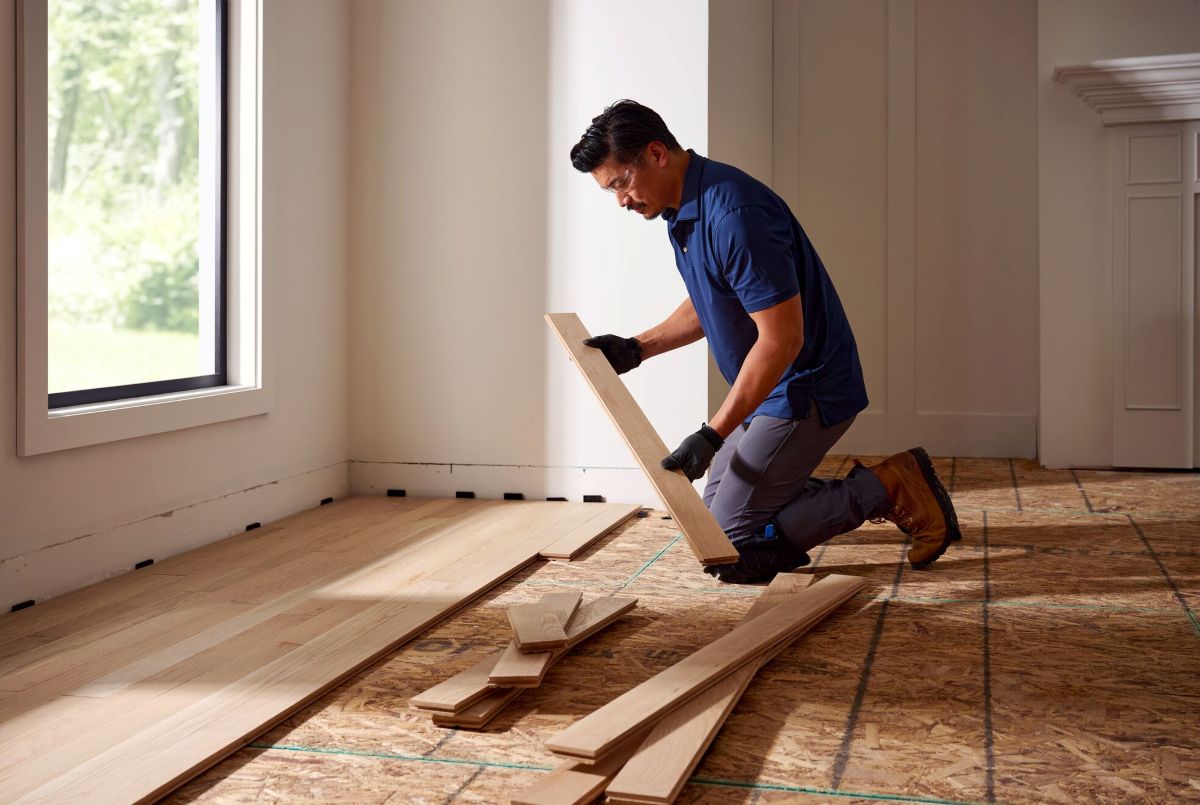
Before installation, remember to acclimate your new flooring. Skipping this step increases the risk of excessive expansion, contraction, gaps, or cupping after installation.
Why Is Acclimation Important?
Before installation, hardwood flooring must acclimate to the home’s interior environment. The process allows the wood to adjust to temperature and humidity conditions before being secured in place.
Skipping acclimation increases the risk of excessive expansion, contraction, gaps, or cupping after installation.
Maintaining indoor humidity between approximately 30% and 50% helps support long-term dimensional stability.
For a more in-depth understanding of the process, read Acclimating Wood Floors: Skipping This Step Can Cost You Later.
What Are the Main Installation Methods?
You can install hardwood flooring in several ways. The correct method depends on both the flooring construction and the type of subfloor beneath it. Solid and engineered products install differently, and selecting the proper method helps ensure long-term stability and performance.
Below are the most common installation approaches used in residential applications.
Nail-Down Installation
Solid hardwood is most commonly installed using a nail-down method over a wood subfloor. Boards are mechanically fastened to the subfloor to provide stability while still allowing natural seasonal movement.
This method typically involves installing traditional 3/4-inch solid hardwood planks.
Glue-Down Installation
Engineered hardwood is often glued directly to a concrete subfloor using specialized adhesives. This approach is common in below-grade spaces or homes built on slab foundations.
Moisture testing of the concrete is critical before installation.
Floating Installation
Some engineered hardwood products can be installed as floating systems, meaning the boards connect without being directly fastened to the subfloor.
Floating systems can simplify installation in certain environments, but still require a stable, level substrate.
Why Is Subfloor Preparation So Important?
Regardless of installation method, subfloor preparation is critical to long-term hardwood performance.
A stable, level, and dry foundation helps prevent common issues such as squeaking, buckling, gaps, and uneven wear. Moisture control is especially important with wood flooring. Excess moisture beneath the floor can lead to cupping, warping, or adhesive failure over time.
Professional installers typically verify that the subfloor is:
- Clean and free of debris
- Structurally sound
- Flat within manufacturer tolerances
- Within acceptable moisture levels
Many flooring warranties require documented subfloor preparation and moisture testing before installation. Skipping these steps can compromise both performance and warranty coverage.
Should You Hire a Professional to Install Hardwood Flooring?
Hardwood flooring is a long-term investment, and the quality of installation directly affects how the floor performs over time.
While experienced homeowners may attempt certain installation methods, professional installation helps reduce the risk of common issues such as gaps, squeaking, buckling, or improper expansion spacing. Wood flooring requires moisture testing, acclimation, precise layout, and correct fastening techniques to ensure long-term stability.
Professional installers also complete projects more efficiently. What may take a homeowner several weekends can often be completed in a matter of days by an experienced crew.
Professional Installation Helps Protect Manufacturer Warranties
In addition, many flooring manufacturers require installation in accordance with published guidelines. Failure to meet those standards can affect warranty coverage.
For straightforward floating-engineered systems, some confident DIYers may opt to install them themselves. However, for nail-down solid hardwood or glue-down applications over concrete, professional expertise is typically recommended.
Because hardwood floors last for decades, proper installation plays a critical role in protecting that investment.
How Do You Maintain Hardwood Flooring?
Proper maintenance preserves both the appearance and structural integrity of hardwood floors. While hardwood is durable, routine care protects the finish and helps extend the floor’s life.
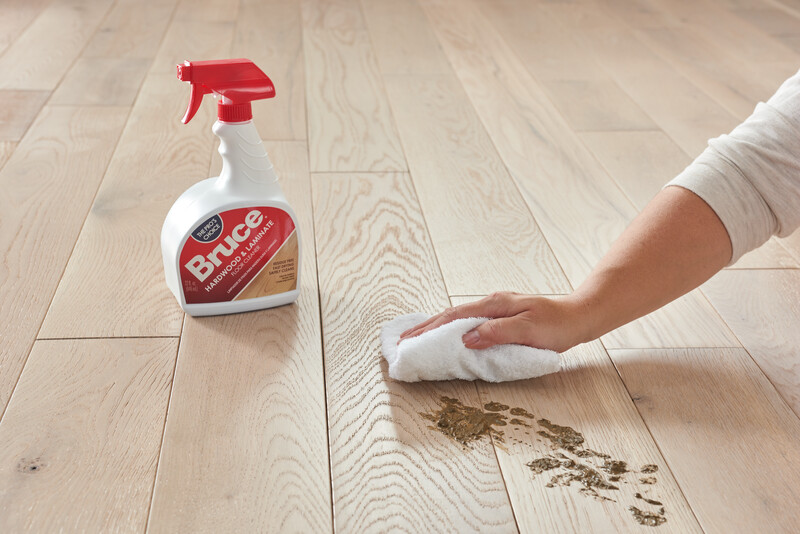
Clean your floors regularly to remove abrasive dirt that causes scratches. That helps preserve the protective finish and prevent moisture from damaging the wood. Daily sweeping and weekly mopping protect your investment.
What Is the Best Way to Clean Hardwood Floors?
Regular cleaning helps prevent surface scratches caused by dirt and debris.
Homeowners should:
- Sweep or dust-mop frequently to remove loose particles
- Vacuum using a hardwood-safe attachment without a beater bar
- Clean periodically with a pH-neutral hardwood floor cleaner and a lightly damp microfiber mop
Avoid excessive water, as prolonged exposure to moisture can damage wood fibers and compromise the finish.
How Can You Prevent Scratches and Wear?
Preventative measures make a meaningful difference over time.
- Place mats at entryways to trap dirt
- Use felt pads under furniture legs
- Trim pet nails regularly
- Avoid walking on hardwood with cleats or high heels
Lower-sheen finishes, such as matte or satin, also help conceal everyday wear.
Why Is Indoor Humidity Important?
Hardwood is a natural material that expands and contracts with changes in humidity. Maintaining indoor humidity levels between approximately 35% and 55% helps reduce excessive seasonal movement.
Consistent environmental control supports dimensional stability and long-term performance.
How Often Should You Refinish Hardwood Floors?
Solid hardwood can typically be sanded and refinished multiple times over its lifespan. Engineered hardwood may also be refinished, depending on the veneer thickness.
Refinishing restores surface appearance and can extend the usable life of the flooring for decades.
For a comprehensive breakdown of cleaning practices, seasonal care, and long-term maintenance strategies, see The Ultimate Guide to Hardwood Floor Care.
Commonly Asked Questions About Hardwood Flooring
Still have questions about hardwood flooring? We’ve compiled answers to some of the most frequently asked questions by homeowners.
Is hardwood flooring a good investment?
Hardwood flooring is often viewed as a long-term investment because it can be refinished rather than replaced. When properly installed and maintained, hardwood floors can last for decades and may add to a home’s resale value.
What is the difference between solid and engineered hardwood?
Solid hardwood is made from a single piece of lumber and offers maximum refinishing potential. Engineered hardwood features a real wood veneer over a layered core, which improves dimensional stability in changing humidity conditions.
What is the most durable hardwood species?
Durability depends on species and finish system. Hickory ranks among the hardest of the commonly used domestic species, while oak and maple perform well in most residential applications. Finish quality and installation conditions also influence long-term wear.
Can hardwood floors be installed in basements?
Engineered hardwood is generally more suitable for below-grade installations due to its layered construction. Solid hardwood is typically recommended for above-grade installations over wood subfloors.
How long do hardwood floors last?
Solid hardwood floors can last 50 years or more, depending on species, maintenance, and refinishing cycles. Engineered hardwood lifespan depends largely on veneer thickness and overall construction quality.
Prefinished vs Site-Finished: Which Is Better?
Prefinished hardwood offers faster installation and consistent factory-applied durability. Site-finished hardwood allows greater customization of stain color and sheen. The best option depends on whether homeowners prioritize installation speed or design flexibility.
Can Hardwood Flooring Be Installed in Kitchens?
Yes, you can install hardwood flooring in kitchens as long as you manage moisture properly. Many homeowners choose harder species and durable finishes to help resist daily wear. Clean promptly, and keep indoor humidity stable to support long-term performance.
Are hardwood floors waterproof?
Hardwood floors are not waterproof. While finishes provide surface protection, prolonged exposure to moisture can cause expansion or warping. Proper humidity control is essential.
America is Built on Bruce® Flooring
Hardwood flooring has shaped American homes for generations. From early plank installations to modern engineered innovations, wood remains one of the few materials that balances structural integrity with natural beauty.
It adapts to design trends without losing its identity. It can be restored rather than replaced. And when properly cared for, it becomes part of a home’s long-term story.
Few brands have contributed to that legacy as consistently as Bruce.
A Flooring Industry Leader Since 1884
For more than a century, Bruce has focused on making hardwood flooring accessible to American homeowners.
By combining traditional craftsmanship with modern performance advancements, Bruce continues to serve as a trusted source for hardwood floors across a wide range of styles and construction types.
From species selection and construction methods to maintenance guidance and long-term care resources, Bruce remains committed to helping homeowners make informed decisions about real wood flooring.
Hardwood flooring isn’t simply a surface choice. It’s a long-term investment in both structure and design.
And for generations, Bruce has been a major part of that story.