
Engineered White Oak Flooring: An American Favorite Made Better
Solid oak has been the standard for American hardwood floors for generations, and it earned that position honestly.
Oak’s reputation for toughness isn’t marketing. It’s the same density and tight grain structure that made it the material of choice for wooden ship hulls for centuries. That kind of performance history matters when you’re choosing flooring that needs to survive decades of daily life.
But solid oak isn’t perfect. It has some vulnerabilities around moisture and long-term stability that no amount of finish can fully solve. Engineered construction doesn’t abandon what makes oak great. It fixes what doesn’t work.
“Solid oak earned its reputation for a reason. Our job with engineered construction isn’t to replace that reputation. It’s to remove the limitations that kept oak from performing in every part of the home.”
— Devon McGrorty, Marketing Manager, AHF
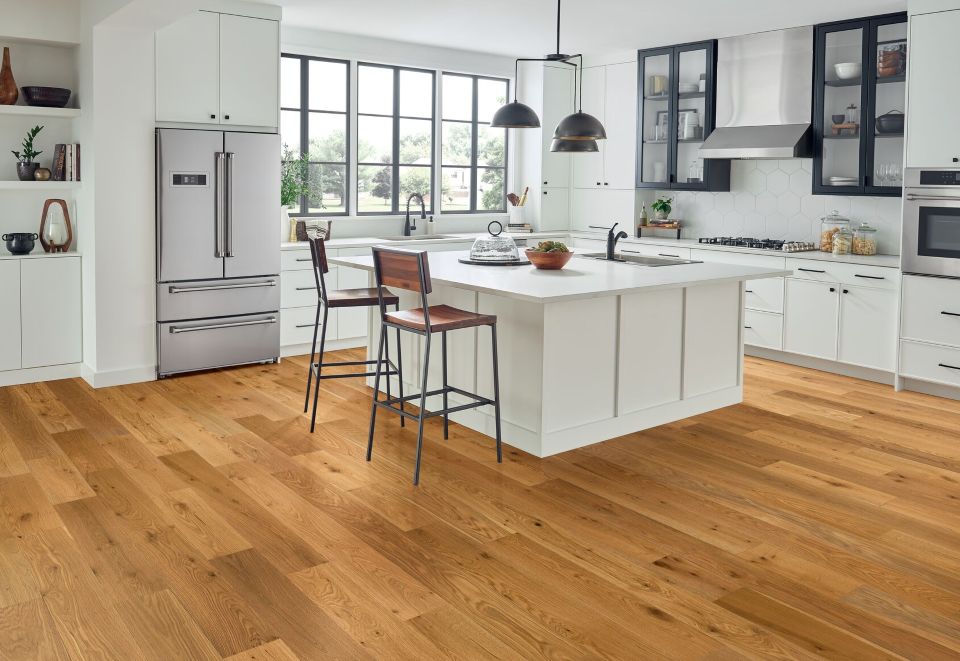
Key Takeaways
- White oak and red oak together account for more than 60% of hardwood flooring sold in the U.S.
- Engineered construction now makes up roughly 75% of the domestic wood flooring market.
- Oak’s natural density and closed-pore structure give it built-in durability and moisture resistance that few hardwoods match.
- Engineered white oak improves on solid oak’s two real weaknesses: moisture sensitivity and dimensional instability.
- Factory-applied finishes outperform jobsite finishing in scratch and wear resistance.
Why Oak Became America’s Flooring Standard
White oak and domestic red oak collectively account for over 60% of hardwood flooring sold by volume in the U.S. Red oak holds roughly 36% of the market and white oak around 28% (Source: Mordor Intelligence). That dominance isn’t a trend. Oak outperforms most alternatives for most homes.
White Oak Is Naturally Water Resistant
Part of that performance comes from oak’s long history outside of flooring. Shipbuilders have relied on white oak for centuries, especially for its natural water resistance. A closed-pore grain structure makes it significantly less absorbent than many other hardwoods. The same characteristic that kept wooden ships seaworthy is what makes oak a strong choice for a floor.
White Oak’s Hardness Lets It Hold Up to Wear
Oak also holds up. White oak rates around 1,360 on the Janka hardness scale. That’s a meaningful step above many domestic hardwoods, and more than tough enough for daily foot traffic, dropped items, and pets.
White Oak Is a Sustainable Wood Flooring Option
Oak is abundant. Healthy, well-managed oak populations across North America make the oak flooring supply chain far more sustainable than that of scarcer or slower-growing species.
Why White Oak Instead of Red Oak?
White oak flooring has become a popular choice for many homeowners because of its more contemporary look. It has longer grain patterns and cooler undertones. Plus, its broader color range fits today’s design trends while keeping oak’s legendary durability.
Combined with engineered construction, it blends traditional strength with modern style in a hard-to-match way. It does so without sacrificing the performance that made oak the standard in the first place.
Where Solid Oak Falls Short
None of that changes one fact: solid wood moves.
Solid oak planks are a single piece of wood from top to bottom. Solid wood expands and contracts as humidity and temperature change. In a basement, over concrete, in a humid climate, or near a kitchen sink, that movement becomes a problem. Over time, floors can cup, gap, and warp.
Solid hardwood also can’t go below grade and struggles with radiant heat systems. That rules it out for many of the rooms where homeowners actually want hardwood.
“Wood movement isn’t a manufacturing defect. It’s just what solid wood does. Engineered construction is an engineering solution to a physics problem, not a way to compensate for a lesser material underneath.”
— Travis Bjorkman, Principal Scientist, AHF
How Engineered Construction Improves Performance
Engineered white oak keeps the real oak wear layer on top but replaces the solid core with cross-layered plywood or high-density fiberboard. But the surface layer is the same wood, with the same grain and performance characteristics as natural white oak.
That layered core is what solves the problem. Cross-graining the layers beneath the surface counteracts the natural expansion and contraction that causes solid wood to move. That, in turn, dramatically improves dimensional stability.
The result is a floor that can go where solid oak can’t. You can install it over concrete slabs, in basements, over radiant heat systems, and in homes with seasonal humidity swings.
Solid Oak vs Engineered Oak Hardwood
| Solid White Oak | Engineered White Oak | |
| Moisture Stability | Prone to cupping, warping | Cross-layered core resists movement |
| Installation Locations | Above-grade only | Works below-grade and over concrete |
| Radiant Heat Compatible | Not recommended | Yes |
| Finish | Often site-finished | Factory-applied, cured finish |
| Refinishing | Multiple times over decades | Limited by wear layer thickness |
| Janka Hardness | 1,360 | Same, real oak wear layer |
The Finish Matters as Much as the Construction
Engineered white oak’s advantage isn’t limited to what’s underneath the surface.
Roughly 85% of wood flooring sold today is factory-finished rather than finished on-site. That shift matters more than most homeowners realize. Factory finishing occurs under controlled conditions. Finishes, often aluminum oxide, are cured with heat and UV light to a hardness that a job-site application can’t match.
The result is a factory-cured finish that resists scratching, scuffing, and everyday abrasion significantly better than a finish applied and air-dried in an occupied home.
“A factory-cured finish isn’t just more convenient. It’s measurably more durable. We’re applying coatings under conditions no contractor can recreate on-site, and that difference shows up in how the floor performs ten years in.”
— Travis Bjorkman, Principal Scientist, AHF
Advancements in White Oak Engineered Hardwood
Standard engineered construction solves oak’s stability problem. Some homeowners, though, may want even more performance from an engineered wood floor. Think active families, multiple pets, and high-traffic homes.
Bruce® helps address those homeowners’ concerns with Dogwood Pro™ densified hardwood flooring. It pushes oak’s natural durability beyond what conventional engineered hardwood can offer.
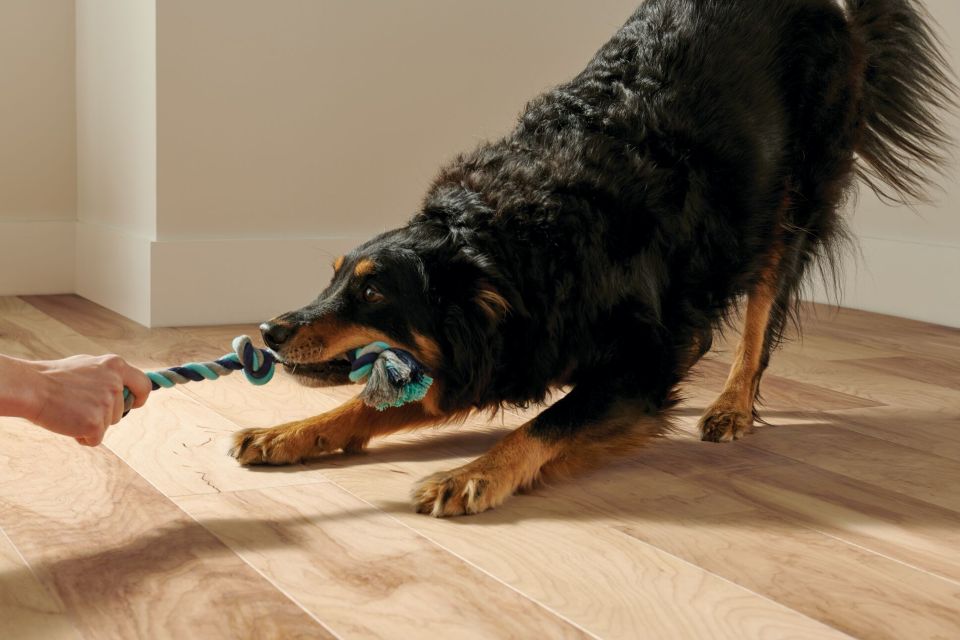
Dogwood Pro™ Raises the Bar for White Oak Engineered Flooring
Dogwood Pro uses a patent-pending densified wood process that hardens the wood itself, not just the top finish. The result is still 100% real oak, no fillers or additives. But the oak is structurally hardened to perform at a different level.
The numbers make the case. White oak’s natural Janka hardness rating of 1,360 already places it above most domestic hardwoods. Densified, that same oak reaches a hardness rating of more than 3,000. That puts it in a different durability category altogether in practical terms vs. standard engineered hardwoods:
- 4 times the scratch resistance
- 8 times the dent resistance
- 8 hours of waterproof protection
“Densified wood isn’t a coating or a harder finish sitting on top of regular oak. We’re changing the wood itself at a structural level, which is why the performance numbers are as dramatic as they are.”
— Travis Bjorkman, Principal Scientist, AHF
For most homes, standard engineered white oak delivers more than enough durability for daily life. For homes that need flooring built around large dogs, heavy foot traffic, or a higher tolerance for accidents, Dogwood Pro extends oak’s natural toughness into territory standard solid and engineered hardwoods can’t reach.
What Doesn’t Change with Engineered White Oak Flooring
Engineered construction improves on solid oak. It doesn’t replace what made oak worth choosing in the first place.
The wear layer on a quality engineered white oak floor is 100% real oak. Unlike synthetic floors, it’s not a printed image, nor a veneer mimicking its look. The grain, hardness, and natural color variation between boards are genuine characteristics of the wood itself. Engineered construction solves a structural problem. It doesn’t change what oak actually is.
“Homeowners aren’t choosing between real oak and something that looks like oak. They’re choosing between two ways of putting real oak on the floor. One that’s vulnerable to moisture and movement, and one engineered to perform better without giving up what oak is.”
— Devon McGrorty, Marketing Manager, AHF
Is Engineered White Oak Right for Your Home?
Engineered white oak is the stronger choice for most homeowners today, particularly for:
- Homes with basements, concrete subfloors, or radiant heat systems where solid oak isn’t an option
- Regions with significant seasonal humidity swings
- Kitchens, entryways, and other moisture-prone areas
- Homeowners who want a factory-cured finish with stronger scratch resistance from day one
Solid oak still has a place. It’s ideal for stable, climate-controlled, above-grade spaces. Solid white oak flooring also lets you sand and refinish it many times over decades. But in most modern homes, engineered construction provides a foundation that supports oak’s genuine performance.
Bruce Delivers Everyday Performance You Can Count On
Since 1884, Bruce has been providing American homeowners with dependable hardwood solutions. The flooring features American craftsmanship, with hardwoods manufactured in the USA.
Choose from over 380 solid and hardwood collections, including white and red oak, maple, hickory, ash, birch, cherry, and walnut.
Explore Bruce’s engineered white oak collections to find the finish, plank width, and construction built to perform in your home’s specific conditions. Or stop by a local retailer to view all our hardwood collections firsthand.