
Waterproof Wood Flooring: Real vs. Wood-Look Options
Published June 3, 2026 | Bruce® Flooring Experts
Wood floors are timeless, but not when they fall prey to moisture. And let’s face it. If you’re a homeowner, especially one with children or pets, you’ll likely encounter water-related concerns.
The answer? You might not be aware that waterproof wood flooring exists. More homeowners are opting for waterproof options that don’t sacrifice style over traditional hardwood.
Waterproof wood flooring isn’t just a passing trend. It’s a direct response to how families actually live. From kitchen spills to basement humidity, consumers want the warmth of wood with the peace of mind that moisture protection provides.
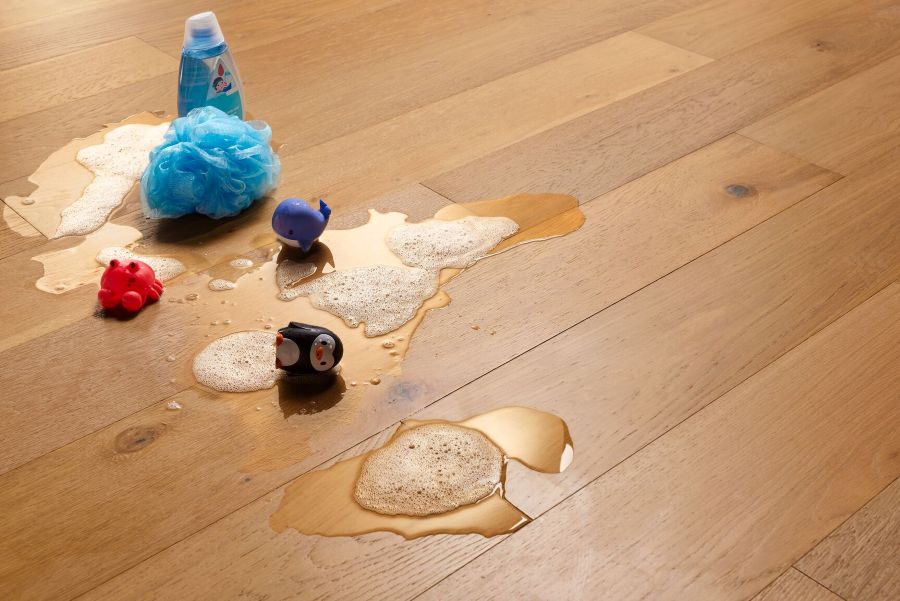
The Waterproof Flooring Market is Exploding
For example, the Waterproof Flooring Market Revenue was valued at $9.5 billion in 2024. It’s estimated to reach $15.2 billion by 2033, growing at a CAGR of 6.2% from 2026 to 2033 (TrendSprout).
Online searches back that up. You likely stumbled onto this blog through a search.
Well, more people are using AI tools and voice search to ask specific, natural-language questions like:
- “Is natural wood flooring waterproof?”
- “What does waterproof actually mean for flooring?”
- “What’s the difference between water-resistant and waterproof?”
- “Can waterproof wood floors be damaged by water?”
If you’re asking these same questions, you’re not alone. And you’re in the right place.
Key Takeaways
- Solid hardwood is never waterproof, but engineered hardwood can be.
- Bruce Hydropel™ and Dogwood® Pro are genuine wood waterproof options.
- Most other “wood” waterproof floors are wood-look synthetics (vinyl, laminate, porcelain).
- “100% waterproof” protects against spills, not floods.
Is Solid Hardwood Flooring Waterproof?
Let’s start with that most basic question. The question is among the most common and confusing for homeowners.
Here’s the truth: No solid hardwood flooring is inherently waterproof out of the box. Solid wood is a natural, porous material. And natural wood absorbs water, which can lead to warping, swelling, and even mold growth.
Why Solid Hardwood Falls Short
The higher the humidity or moisture, the more susceptible solid wood flooring becomes. Some woods, like oak, have inherent water resistance. But that’s a far cry from waterproof.
“Even with advanced finishes, solid wood isn’t waterproof. We can make it more water-resistant with sealants. But it’s still not an ideal solution for exceptionally high-moisture areas.”
Travis Bjorkman, Principal Scientist, AHF™
If waterproofing is your primary goal, you must turn to engineered products. Some, like engineered hardwood, use real wood. Others, such as rigid-core luxury vinyl flooring, feature a waterproof core but offer realistic wood looks.
Solid Wood Isn’t Waterproof
So, to be 100% clear: solid wood equals no waterproofing. Truly waterproof flooring is either engineered or a wood-look synthetic product. In short, if a floor is made from a single piece of natural wood, it can never be entirely waterproof.
Waterproof vs. Water-Resistant: What’s the Difference?
Now that we’ve ruled out solid wood, it’s time to understand the terms you’ll see on every flooring label. “Waterproof” and “water-resistant” aren’t marketing fluff. They effectively tell you how long a floor can withstand moisture.
People often use these two terms interchangeably. However, they mean different things when it comes to flooring.
Water Resistant Floors: Quick Spill Protection
Water-resistant flooring can handle small spills, splashes, or humidity. However, you must wipe up the water fairly quickly. Otherwise, the water can seep into the flooring. Standard engineered flooring falls into this category.
Waterproof Floors: Built for Messes
Waterproof flooring prevents water from penetrating the surface or core, even with prolonged exposure. Even there, prolonged exposure usually means a limited time, generally 24 to 72 hours.
For example, Bruce Hydropel™ waterproof engineered hardwood repels water for roughly 24 hours. The bottom line? You must still wipe up the water with some urgency, though not as much as with standard engineered flooring.
Spills vs. Standing Water
Think of it like this:
- A water-resistant floor might survive a spilled drink
- A waterproof floor might survive a dishwasher leak without buckling, warping, or mold creeping in
“Waterproof floors block water from the inside out. That includes the core, surface coating, and locking systems all working together.”
Travis Bjorkman, Principal Scientist, AHF™
This distinction is significant if you’re installing flooring in areas prone to high humidity (such as basements) or to frequent spills (such as kitchens). Standard engineered hardwood will suffice.
However, for standing water, such as that found in bathrooms, waterproof flooring is the solution.
If your floors need to survive real-life messes, waterproof is what you’re looking for.
What Does “100% Waterproof” Really Mean?
You’ve probably seen flooring marketed as 100% waterproof. And it’s one of the most common questions people ask online: “What does 100% waterproof really mean?” Let’s break it down.
What 100% Waterproof Means
Floors labeled as 100% waterproof can withstand standing water for a limited time, as verified by tests such as the 100-Hour Water Test.
- The planks themselves won’t absorb water or swell
- Surface coatings and locking systems keep spills on top of the floor
What 100% Waterproof Doesn’t Mean
In practice, here’s what you should know:
- It doesn’t prevent water from seeping around the edges or into your subfloor
- It doesn’t make the floor flood-proof, as prolonged standing water can still cause damage
- It doesn’t apply to solid hardwood, which is never inherently waterproof
“Waterproof flooring is designed for everyday life—spills, splashes, and pet messes. But no flooring is built to survive days of standing water. That’s why installation and upkeep still matter.”
Travis Bjorkman, Principal Scientist, AHF™
Bottom line: 100% waterproof means protection against life’s daily messes, not a guarantee against disaster.
At a Glance: Waterproof Flooring Comparison
With those definitions in mind, here’s how each flooring type compares in terms of real wood content and waterproof performance. Only one—engineered hardwood—is made with genuine wood.
| Flooring Type | Real Wood | Waterproof Claim | Core Composition | Best For |
| Engineered Hardwood (Hydropel™, Dogwood® Pro) | ✅ | Water-resistant or limited waterproof protection (up to 24 hrs) | Multi-layer wood with protective sealants | Kitchens, living areas |
| Luxury Vinyl (LVP/LVT/Rigid Core) | ❌ | Waterproof | Vinyl or SPC core | Basements, baths, laundry |
| Laminate (TimberTru™) | ❌ | Waterproof surface & sealed edges | HDF core | Budget-friendly spaces |
| Wood-Grain Porcelain Tile | ❌ | Naturally waterproof | Porcelain | Baths, entries, laundry |
5 Types of Waterproof Wood and Wood-Look Flooring
Now that all the explanations are out of the way, what are your waterproof wood flooring options?
Understanding how moisture protection works is one thing. Knowing which products deliver it is another. Let’s look at the flooring options that claim “waterproof” status and see which ones actually qualify.
1. Waterproof Engineered Hardwood
Engineered hardwood provides a genuine wood surface, but the difference lies beneath. Instead of a single solid plank, engineered hardwood comprises multiple layers. Typically, it features a water-resistant or waterproof core, generally high-density fiberboard (HDF).
Top-tier engineered products also feature:
- Water-tight click-lock systems
- Sealed edges and surface coatings
- Dimensional stability to resist swelling or warping
“It’s the best of both worlds. Real wood on top, protection underneath. That’s what makes waterproof engineered hardwood ideal for modern homes.”
Travis Bjorkman, Principal Scientist, AHF™
What is Hardened Wood Flooring?
Bruce Dogwood® Pro is a waterproof engineered hardwood featuring densified wood technology. It not only offers waterproof protection but also enhances the flooring’s durability.
Using heat and pressure, the wood’s cells are compressed, creating a harder surface. The net is four times more scratch-resistant and six times more dent-resistant. Equally important, it’s 100% real wood. No acrylics.
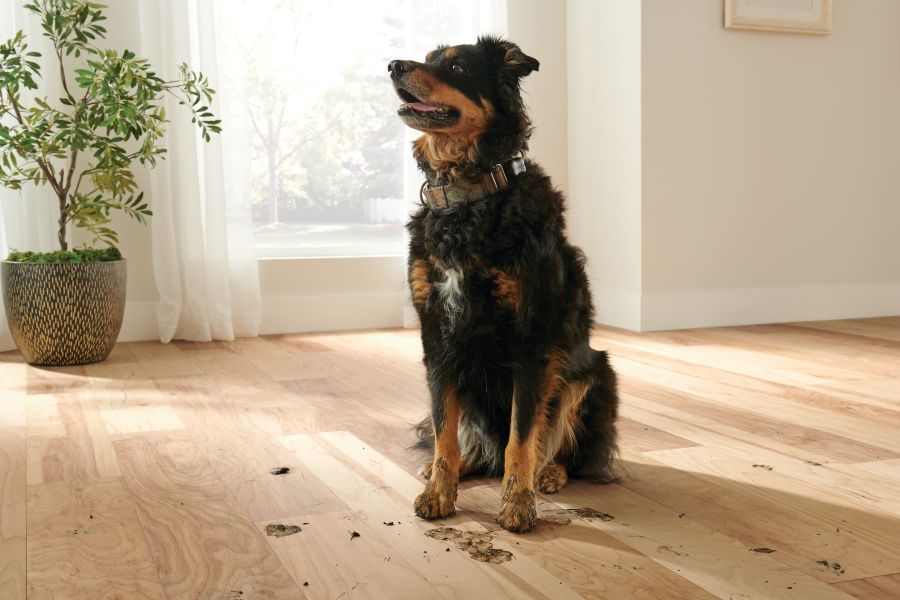
Dogwood Pro also includes Cleantivity™, an antimicrobial coating offering several benefits:
- Inhibits bacterial growth
- Protects against mold and mildew
- Helps reduce odors
As the name implies, Dogwood Pro is perfect for pets. Plus, you can install it anywhere in your home.
2. Luxury Vinyl Wood Flooring
Luxury vinyl plank (LVP) flooring isn’t real wood, but most people can’t tell the difference unless they look closely.
Luxury Vinyl Use is Growing Fast
Luxury vinyl isn’t just a fad, exploding from 4% to 31% of the U.S. flooring market between 2012 and 2022, growing at an annual rate of 28% (Freedonia Group).
Moreover, the vinyl flooring market in the U.S., including LVP, is expected to grow from $12.6 billion in 2025 to $18.1 billion by 2030, at a 7.5% CAGR (Mordor Intelligence).
What’s the Appeal of Luxury Vinyl?
Luxury vinyl wood flooring has exploded in popularity for good reason: it combines style, strength, and complete waterproof protection in one low-maintenance package.
Homeowners love it because it’s:
- 100% waterproof from top to bottom
- Highly durable, scratch-resistant, and pet- and kid-friendly
Beyond those benefits, luxury vinyl also gives you flexibility in design and construction. It’s available in three main formats:
- Luxury Vinyl Plank (LVP)
- Luxury Vinyl Tile (LVT)
- Rigid Core
Understanding SPC vs. WPC Cores
Rigid core products use either a stone-plastic composite (SPC) or wood-plastic composite (WPC) core. SPC floors are fully waterproof and highly stable, while WPC options are typically only water-resistant.
Because of that layered structure, luxury vinyl shrugs off everyday messes and even moderate flooding. That makes it ideal for high-moisture areas like basements, kitchens, and bathrooms. Just remember that while the planks resist water, your subfloor still can’t.
Simply put, luxury vinyl achieves its waterproof performance through synthetic materials rather than real wood.
4. Waterproof Laminate Wood Flooring
This one might be a surprise, but laminate has evolved. Older versions were notorious for swelling when exposed to moisture. Indeed, laminate was one of the last floors you’d turn to if you had moisture concerns.
Laminate Has Come a Long Way
Today’s waterproof laminate options feature improved cores, secure locking systems, and better protective coatings. Combined, they prevent water from seeping in.
For example, Bruce offers TimberTru™ waterproof laminate wood flooring.
Laminate uses high-definition imaging and embossing to closely mimic the grain and texture of hardwood.
Key benefits:
- Affordable and widely available
- Scratch- and dent-resistant
- Easier to install than tile
The Catch with Laminate
That said, not all laminate flooring is waterproof. Look for products explicitly labeled “waterproof”, not just “water-resistant.” And like vinyl, while the surface may be waterproof, excessive water reaching the subfloor can still cause damage.
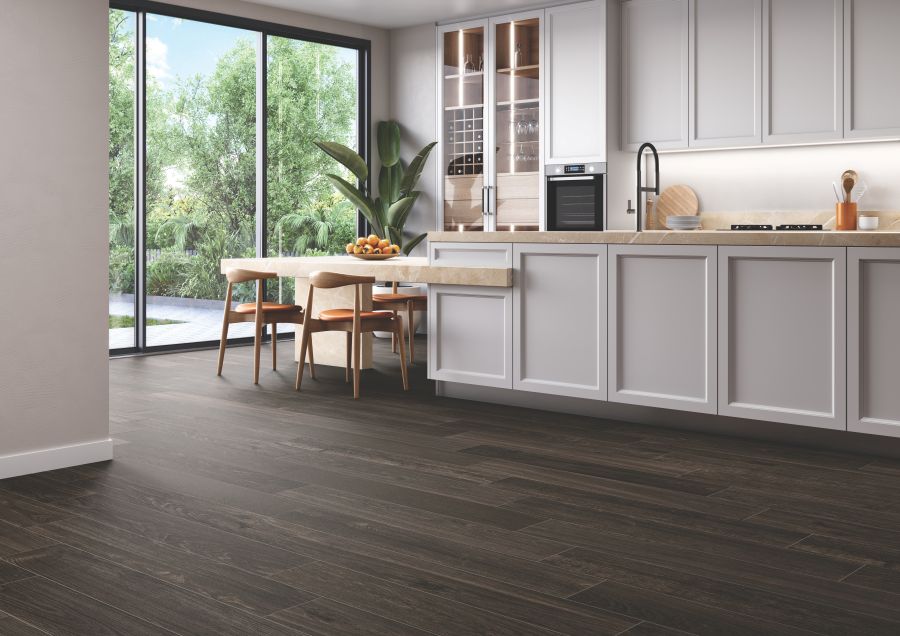
5. Wood Grain Porcelain Tile
Porcelain and ceramic tiles can now mimic wood so convincingly that it’s hard to tell the difference once installed. That’s especially true in larger formats with realistic grain patterns.
For instance, Delicate Expressions™ from Robbins® features 8” x 48” planks in 10 color variations with genuine hardwood looks.
Unlike wood-based products, wood-grain porcelain tile is naturally waterproof. That makes it an excellent choice for bathrooms, laundry rooms, mudrooms, and other areas with high moisture levels.
Why people love it:
- 100% waterproof and mold-resistant
- Extremely durable and long-lasting
- Ideal for wet or outdoor-adjacent spaces
On the downside, tile can be hard underfoot, cold without radiant heating, and more expensive to install.
Keep Your Floors Dry with Bruce®
If you love the look of wood but live in a real-life home — with kids, pets, spills, and surprises — waterproof wood flooring is a smart and stylish upgrade.
Choosing the Right Waterproof Floor for Your Home
Bruce has long been known for its wood flooring, a legacy dating back to 1884. Today, the company has evolved its flooring solutions to include wood-look flooring, fulfilling its commitment to providing homeowners with waterproof solutions.
You can still purchase its legacy-building, solid, and engineered hardwoods. But now, you can buy quality wood-look options:
- Laminate
- LVT
- Rigid Core
American was built on Bruce floors, and it still is. Shop the complete selection of wood and wood-look flooring. Or drop by your nearest retailer to view the collections firsthand.
FAQs: What Homeowners Are Asking About Waterproof Wood Floors
Here are some of the most common homeowner questions about waterproof wood flooring with straightforward answers you can trust.
Is natural wood flooring waterproof?
No — natural hardwood is porous and absorbs moisture. It can swell, stain, and eventually mold.
Can waterproof floors still be damaged by water?
Yes. If water seeps into the subfloor or the edges aren’t correctly sealed, even waterproof floors can be compromised.
What’s the difference between water-resistant and waterproof flooring?
Water-resistant floors can handle spills if cleaned quickly. Waterproof floors are designed to prevent moisture from penetrating, even after prolonged exposure.
Can I make solid hardwood waterproof?
Not completely. You can apply water-resistant finishes or sealants, but it won’t make solid wood waterproof. For high-moisture areas, engineered options are better.
Are waterproof floor warranties bulletproof?
No. Many have specific terms — like “no standing water beyond 24 hours” or “interior use only.” Always read the fine print.